
Overview
CHD2-related developmental and epileptic encephalopathy is one of the most light-sensitive members of childhood genetic epilepsies: flashes, flickering screens, the "flicker" of tree shadows on a sunlit road, and water reflections can directly trigger seizures. The typical picture is a combination of myoclonic jerks beginning at 1-4 years of age (often 2-3 years), absences with eyelid myoclonia, and sudden falls, together with varying degrees of developmental impairment and autistic features. In a group of children, a self-triggering behaviour (looking at light, hand-waving) is seen — this is not naughtiness but a recognised part of the disease, and it is central to the management plan.
Genetic Cause and Mechanism
- CHD2 encodes an enzyme that remodels chromatin (the "stage director" of gene-reading programmes). Variants are almost always de novo and cause disease through haploinsufficiency (a single copy not being sufficient); sibling recurrence risk is low (~1%, with a share attributable to gonadal mosaicism).
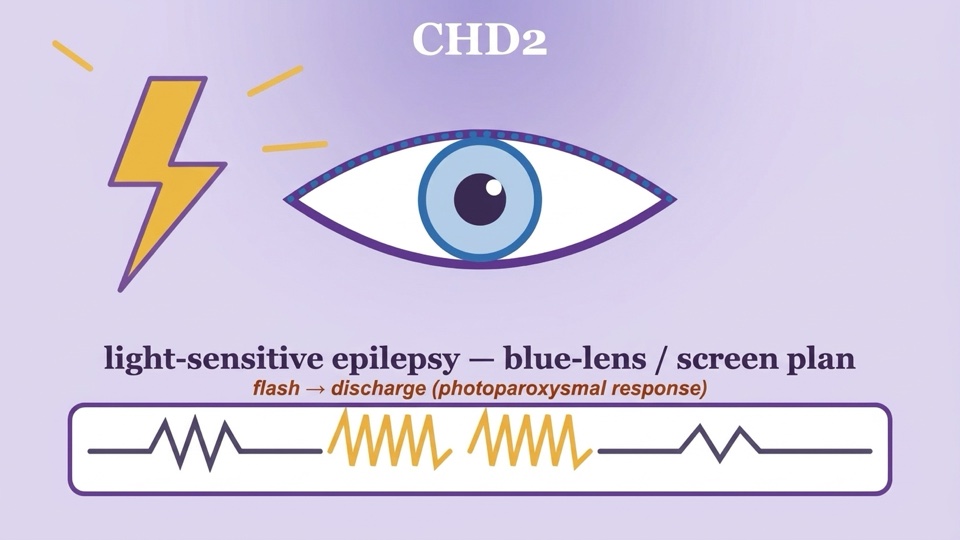
- Few genes show photosensitivity as prominently as this one — a photoparoxysmal response is typical even with low-frequency intermittent photic stimulation on EEG, and a history of "television/tablet seizures" before diagnosis is a frequent clue.
- VUS results should be reclassified every 1-2 years.
Clinical Picture
Epilepsy
- Onset is often at 1-4 years of age: myoclonic jerks, absences with eyelid myoclonia (Jeavons-like: rapid eyelid fluttering + upward gaze + brief lapse), atonic falls and generalised tonic-clonic seizures; a history of febrile seizures may precede onset.
- Photosensitivity is a hallmark: screens, flashes, disco lights, sun-shade transitions, bright water surfaces... In some children, a self-triggering behaviour through eye closure/looking at light is also seen.
- Prolonged periods of blankness or daze may be absence status — this should not be dismissed as "tiredness" and should be investigated with EEG.
- EEG: generalised spike/polyspike-wave discharges plus photoparoxysmal response; sleep activation may be seen.
Development and behaviour
- Developmental impairment ranges from mild to marked; a plateau or regression may be seen with the onset of seizures — this may partly recover as seizure control improves.
- Autism spectrum features, attention and behavioural problems are common; anxiety and mood follow-up is needed in adolescence.
Diagnosis
- Genetic testing: epilepsy panel/exome; if positive, parental testing (to confirm de novo status) and genetic counselling.
- EEG + intermittent photic stimulation (IPS): documenting the photoparoxysmal response both supports the diagnosis and gives a concrete basis for the protective plan (lens/screen).
- Differential diagnosis: Jeavons syndrome, Doose syndrome (myoclonic-atonic), Dravet syndrome (in early febrile-onset cases), Lennox-Gastaut course and other DEE genes — in the panel era, differentiation is clarified by the molecular result.
Treatment — An Honest Framework
- Drug choice is phenotype-based: in the myoclonic-photosensitive picture, valproate is among the most consistent first choices; levetiracetam (with good reports in myoclonus and photosensitivity), ethosuximide (for absences with eyelid myoclonia) and clobazam are frequently used steps.
- Watch list: carbamazepine, oxcarbazepine and phenytoin can worsen generalised myoclonic seizures — these are avoided in this diagnosis; lamotrigine may increase myoclonus in some patients, and if used, it should be tried slowly with close follow-up.
- Light protection is part of treatment: once photosensitivity is documented on EEG, blue/dark-lensed glasses (in sunlight and, if needed, at the screen), screen hygiene (low brightness, room lighting on, no flashing content viewed up close), and staying away from flash/strobe environments concretely reduce the seizure burden.
- Self-triggering behaviour is managed with a behavioural plan rather than punishment (identifying triggering moments, offering alternative stimuli, glasses); the family and school should use the same approach.
- The ketogenic diet is a reported option in drug-resistant cases.
- In drug-resistant cases, risks including SUDEP should be discussed openly with the physician; night-time monitoring/sensors should be considered on an individual basis.
- Research horizon: approaches aimed at increasing CHD2 expression (e.g., the long non-coding RNA CHASERR axis) are at the preclinical stage; they are at the research stage and are not a recommendation for clinical use.
Three Critical Points in the Emergency Department
- 1 · Drug note: this is a generalised myoclonic syndrome — do not load with CBZ/OXC/phenytoin; in status, valproate or levetiracetam is preferred after benzodiazepine.
- 2 · Prolonged daze may be absence status: confirm with EEG and treat with benzodiazepine plus valproate, monitoring the clinical picture and EEG together.
- 3 · Light trigger: avoid flashing/flickering light sources in the examination room (keep ophthalmoscope flash brief); lower screen brightness for a child kept in front of a monitor.
Follow-up — Summary
The backbone of follow-up: a seizure diary plus videos (jerks/lapses/falls recorded separately) · documentation of photosensitivity with EEG-IPS and yearly updating of the lens/screen plan · at every prescription, checking "not CBZ/OXC/phenytoin, caution with lamotrigine" · helmet assessment if falls occur · a low-threshold EEG for prolonged daze · annual developmental-behavioural/autism assessment plus a school plan (including screen-light adaptations) · sleep routine · bone health (vitamin D) · genetic counselling and VUS reclassification. The detailed age-by-age table is in the Routine Follow-up Calendar document at the end of the article.
Prognosis — An Honest Framework for Families
- The seizure course is variable: in one group of children, good control is achieved with medication plus light protection; in another, the course is fluctuating and drug-resistant. Photosensitivity often softens in adolescence but may not disappear completely.
- Development does not show progressive loss; plateaus during seizure-heavy periods may partly recover once control is achieved. The main long-term concern is in the area of learning, behaviour and anxiety.
- With light protection and the correct choice of medication, daily life (school, sport, social life) can largely be maintained.
Daily Life
- Screen rules: low brightness, bright room, and a break routine; avoid flashing game/video content; plan ahead for environments with strobe risk such as cinemas and concerts.
- On sunny days (especially tree-lined roads in a moving vehicle, or sea/pool reflections), do not forget the glasses.
- Record episodes on video; a note on "was it triggered by light?" informs the medication and protection plan.
- A written school plan: screen-light adaptations, repeating questions during a lapse, seating arrangements in case of falls.
- Join CHD2 family communities — this is a way of preparing for the research era.
Downloadable Documents: Emergency Action Plan + Routine Follow-up Calendar (PDF)
Two documents have been prepared for children with CHD2 by Nörogender, under the guidance of Prof. Dr. Burak Tatlı. The Emergency Action Plan (3 pages): alongside the 5-minute rule, avoidance of CBZ/OXC/phenytoin and caution with lamotrigine, the rule "prolonged daze = possible absence status → EEG", and light-trigger precautions in the emergency setting. The Routine Follow-up Calendar (2 pages): an age-by-age table and recording chart covering the EEG-IPS/lens-screen plan, prescription checks, developmental-behavioural assessment and school adaptations.
📄 Emergency Action Plan (PDF, 3 pages) — in Turkish 📅 Routine Follow-up Calendar (PDF, 2 pages) — in Turkish
Complete the documents together with your physician; keep a copy at home and at school, and update the rescue medication dose as weight changes.