
Overview
Dravet syndrome is a rare developmental and epileptic encephalopathy that begins in the first year of life with fever-sensitive, prolonged seizures, and that also affects development in later years. It occurs in approximately 1 in 15,000-40,000 births. An accurate diagnosis is decisive for two reasons: some commonly used seizure medicines can worsen Dravet, and disease-specific treatments and gene-directed research are advancing rapidly.
Genetic Cause and Mechanism
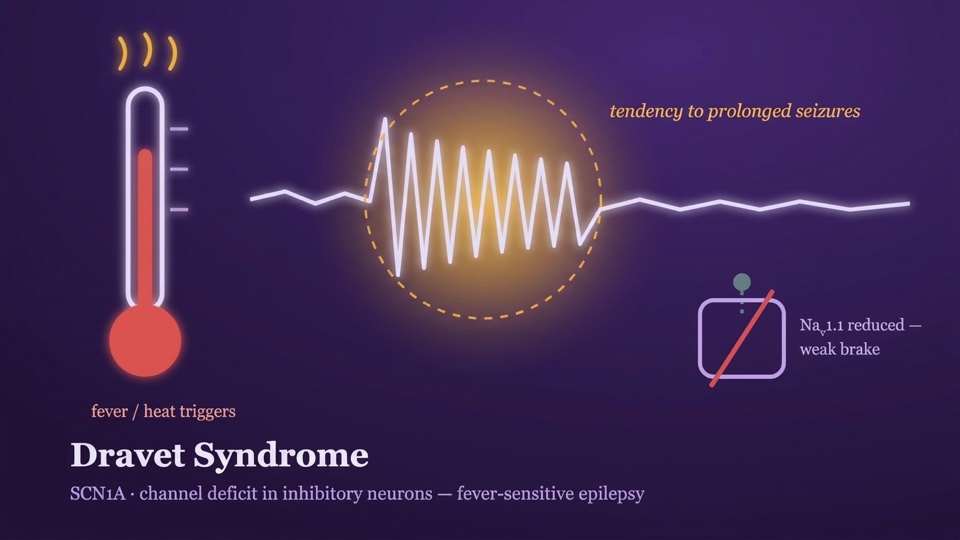
A disease-causing change is found in the SCN1A gene in 80-90% of patients. SCN1A encodes the sodium channel (Nav1.1) that the brain's inhibitory (GABAergic) interneurons need in order to fire. Insufficiency of a single copy (haploinsufficiency) weakens this brake: the brain easily "overheats" — this is the biological explanation for why seizures are triggered by fever and heat.
- About 90% of the changes are de novo (not present in the parents).
- In the small number of inherited cases, a parent may have a mild presentation or mosaicism — this matters for counselling about future pregnancies.
- Milder changes in the same gene can cause conditions with a better course, such as GEFS+; that is, being "SCN1A positive" alone does not mean Dravet syndrome — it must be interpreted together with the clinical picture.
- In SCN1A-negative cases with a similar presentation, other genes should be considered, particularly PCDH19 in girls.
Clinical Course — Stage by Stage
Stage 1: The first year ("febrile onset")
- Usually at 4-8 months of age, prolonged seizures triggered by fever or post-vaccination fever, often affecting one side of the body (hemiclonic) or generalised
- Seizures easily exceed 5 minutes; the risk of status epilepticus is high
- During this period, development and EEG are usually normal — this may be mistaken for a "simple febrile seizure", delaying diagnosis
When should Dravet be suspected? In an infant under 1 year of age, a prolonged, one-sided seizure triggered by fever or a warm bath, recurring at short intervals → genetic testing should not be delayed.
Stage 2: Ages 1-5 ("the turbulent period")
- Seizure variety increases: myoclonic jerks, atypical absences, focal and atonic (drop) seizures
- Triggers become more apparent: fever, warm bathing, air temperature, excitement, and sensitivity to light and patterns
- A slowing in the rate of development is noticed; the language domain is especially affected; attention and behavioural problems and autism spectrum features may be added
- Balance and gait may become coarser; the EEG is now often abnormal, while cranial MRI is typically normal
Stage 3: School age and beyond ("relative stabilisation")
- Convulsive seizures often shift to sleep and night-time hours; myoclonus and absences may decrease
- Cognitive development settles onto a plateau; learning difficulty is permanent, but acquisition of new skills continues
- Crouch gait may develop in adolescence — requiring regular physiotherapy and orthopaedic follow-up
Beyond Seizures: Additional Neurological Problems and Other Systems
Dravet is not only a "seizure disorder"; SCN1A also functions beyond the brain's inhibitory circuits, in the cerebellum, the autonomic system and the heart. The follow-up plan is therefore broader than the seizure diary.
Neurological comorbidities
- Cognition and language: Slowing typically becomes apparent from age 2 onward; the language domain is affected first. Annual developmental assessment and uninterrupted special education and speech therapy are standard.
- Behaviour: Attention-deficit hyperactivity is very common; autism spectrum features, obstinacy and impulsivity may accompany it. A behavioural approach takes priority; if medication is needed, choices are made with the seizure threshold in mind.
- Movement and balance: Ataxia and gross motor clumsiness appear early; in adolescence, crouch gait, and in adulthood, slowing and stiffness of movement (parkinsonism-like findings) may be seen. Regular physiotherapy and gait analysis, orthotic and footwear adjustments are needed.
- Sleep: Night-time seizures together with disrupted sleep architecture and sometimes obstructive apnoea; sleep should be asked about at every visit, and a sleep study requested if needed (poor sleep also lowers the seizure threshold).
Autonomic system and heart
- Thermoregulation disorder: Reduced/irregular sweating and heat intolerance are common — this is one aspect of "heat-triggering"; a summer cooling plan (air conditioning, cold drinks, shade) is part of treatment.
- Circulatory/autonomic findings: Cold, mottled hands and feet and reduced heart rate variability have been reported; because these findings are associated with SUDEP risk, they strengthen the rationale for night-time monitoring measures.
- Cardiac monitoring: SCN1A is also expressed in the heart; rhythm and conduction changes are under investigation. In practice: a baseline ECG is a reasonable step; regular echocardiography is already performed in those taking fenfluramine; palpitations or fainting should be shared with cardiology.
Nutrition, digestion and bone
- Appetite and weight: Poor appetite and low weight are common (stiripentol and fenfluramine can further suppress appetite); the growth chart should be reviewed at every visit, with nutritional support added if needed.
- Constipation and reflux are common; unrecognised constipation sometimes lies behind restlessness, disturbed sleep and increased seizures — simple but important.
- Bone health: Long-term seizure medicines plus limited mobility carry a risk of osteopenia: vitamin D and calcium monitoring, safe weight-bearing exercise; protection against dental and facial trauma from falls.
Other practical points
- Orthopaedic follow-up: Flat feet/foot alignment problems and monitoring of the hips and spine are part of preserving gait.
- Dental health: Regular dental check-ups are needed because of fall-related trauma and medicine-related gum effects; preventive measures if required.
- Periods of infection: Every illness is a "seizure risk window" — alongside the fever plan, fluid intake and keeping to medication schedules should not be disrupted.
Diagnosis
- Diagnosis is based on the clinical picture; an epilepsy gene panel (including SCN1A) should be requested within the first year — early genetic diagnosis prevents the wrong choice of medicine and prevents a prolonged search for a diagnosis
- A negative panel does not rule out Dravet; if the clinical suspicion is strong, further testing (deletion analysis, exome sequencing) is performed
- The EEG may initially be normal; sensitivity to photic stimulation may appear over time
Treatment — Step by Step
First line
Valproate and clobazam are the first choices.
Approved disease-specific medicines
- Stiripentol: Used together with valproate and clobazam; reduces prolonged seizures and status
- Fenfluramine: In studies, a reduction of over 50% in convulsive seizures; used with regular echocardiography monitoring
- Cannabidiol: An approved add-on treatment option
⚠️ Medicines to avoid
Sodium channel blockers — carbamazepine, oxcarbazepine, phenytoin, lamotrigine — can worsen seizures in Dravet. They further suppress the already weak inhibitory neurons. Behind what appears to be "drug-resistant epilepsy" can sometimes be these very medicines; the medication list must always be reviewed at the time of diagnosis.
Other options
- Ketogenic diet: An effective option in drug-resistant cases
- Vagus nerve stimulation (VNS): May reduce seizure burden in selected cases
- Epilepsy surgery (focus resection) is generally not suitable in Dravet
Emergency plan and day-to-day protection
- Every family should have a rescue medicine at home (intranasal/buccal benzodiazepine) and a written seizure action plan — applied when a seizure exceeds 5 minutes, calling 112 (emergency services in Türkiye) if necessary
- Fever is brought down early and consistently; vaccinations are not skipped (vaccination is not the cause of the disease; an antipyretic can be planned for vaccination day if needed)
- Bath water is kept lukewarm; cooling measures in hot weather; screen/sunglasses precautions if there is light sensitivity
Prognosis — An Honest Framework for Families
- Seizures: Complete disappearance is rare; however, frequency generally decreases with age and shifts to the night. The goal is less "zero seizures" than preventing prolonged seizures and status.
- Cognitive development: Most children develop a moderate-to-severe degree of learning difficulty; seizure burden, episodes of status and use of the wrong medicine in the early period affect the course adversely. Early accurate diagnosis plus the right medicine plus intensive developmental support allow the child to reach the top of their own potential.
- Movement: Gait changes (crouch gait) may develop in adolescence; managed with regular physiotherapy.
- Life risk: The risk of loss of life in Dravet is higher than in the general epilepsy population; the main causes are SUDEP (sudden unexpected death in epilepsy) and prolonged seizures. Known ways to reduce the risk: controlling seizures — especially night-time seizures — as much as possible, having a working rescue plan, and night-time monitoring measures (same room/listening device, seizure-sensor monitors). Do not hesitate to discuss this openly with your doctor.
- Adulthood: Individuals with Dravet reach adulthood; from adolescence onward, a transition plan to adult neurology and legal/care arrangements should be discussed.
Treatment Pipeline — A Detailed Look
Among the genetic epilepsies, Dravet is the area where treatments targeting the disease itself are furthest ahead, because the target is clear: increasing production from the intact SCN1A copy.
Zorevunersen (STK-001) — the leading candidate
- How does it work? An antisense oligonucleotide (ASO); it increases protein production by converting inefficiently processed copies of the SCN1A message into efficiently processed ones (the TANGO method) — raising the gene's "own natural production". It is not gene therapy: the gene is not changed, and no new gene is added.
- How is it given? As an intrathecal (into the spine) injection every four months. Because the molecule cannot cross the blood-brain barrier, it is given directly into the cerebrospinal fluid. The effect is maintained with repeated doses — while this may seem a disadvantage compared with a one-time gene therapy, it carries the advantage of reversibility.
The evidence so far — in numbers
- Phase 1/2a (MONARCH, ADMIRAL): 81 children aged 2-18 years, all continuing on standard seizure medicines. Of these, 75 moved on to extension studies (SWALLOWTAIL, LONGWING).
- Seizures: In children who received 70 mg in Phase 1/2a and continued on ≤45 mg in the extension, the median change in monthly convulsive seizure frequency compared with baseline, over the first 20 months of the extension, ranged between -58.82% and -90.91%.
- Cognition and behaviour: In four-year extension data (European Epilepsy Congress, Athens, September 2026), statistically significant improvement compared with the start of the extension was reported in years 1, 2, 3 and 4, throughout. The expected course in Dravet is a plateau or decline; a gain sustained over four years therefore runs opposite to the expected course.
- The most severe seizures: A marked reduction over three years in generalised tonic-clonic seizures and focal-to-bilateral tonic-clonic seizures. These seizure types are the ones most strongly associated with SUDEP risk.
- Continuation: 93% of eligible patients moved on to the extension; at the four-year point, 77% were still in the study — a notable rate for a treatment given intrathecally.
- Publication: Laux L et al. N Engl J Med 2026;394(10):969-982 (doi:10.1056/NEJMoa2506295).
Safety — what is known
- As of 31 July 2026, over 930 doses; some patients have been on treatment for more than five years.
- The most common finding is raised CSF protein: laboratory values rose in ~94% of patients, and a treatment-related adverse event was recorded in 59%. To date there has been no serious clinical consequence linked to this and no report of hydrocephalus.
- In Phase 1/2a, the most common adverse event was post-lumbar-puncture syndrome (25%) — related to the procedure, not the medicine.
- Four deaths were reported during the studies: two were SUDEP, one was due to nutritional insufficiency. This figure should not be taken out of context — nearly 20% of children and adolescents with Dravet do not reach adulthood, and the main cause is SUDEP. In an open-label, uncontrolled design, the relationship of these deaths to the medicine cannot be disentangled.
October 2026: Agreement reached with the FDA — this is the real news
On 5 October 2026, it was announced that agreement had been reached with the FDA on the main elements of the planned US marketing application. At the centre of the agreement is the Vineland-3 multi-domain analysis: in Phase 3, cognition and behaviour will be measured across four pre-specified subdomains — expressive language, receptive language, interpersonal relationships and personal skills. This measure will be the second key secondary endpoint at week 52.
Why this matters: epilepsy medicines have been measured for decades by a single question — has seizure count fallen? A regulatory authority agreeing to count a developmental measure as a formal part of the application file means that, for the first time, the claim of "changing the course of the disease" rests on a measurable counterpart. This decision sets a precedent that concerns not only Dravet but the whole group of developmental and epileptic encephalopathies — CDKL5, SCN2A, SYNGAP1, STXBP1.
Let us be clear about the limits: the agreement concerns how the application will be evaluated, not whether the medicine works. The FDA has accepted the measurement method; no one yet knows the result.
Phase 3 EMPEROR (NCT06872125) — what it is asking
- Who: Children aged 2 to under 18 years with a confirmed non-gain-of-function SCN1A variant.
- How many: 162 patients in the primary analysis group (US, UK, Japan; enrolment closed in June 2026). A further 34 participants in Europe (August 2026); enrolment in China is ongoing.
- How: 1:1 random allocation — intrathecal zorevunersen or sham (a mock procedure performed without inserting a needle). Double-blind; 52 weeks of treatment after an 8-week baseline period.
- Primary endpoint: Percentage change in major motor seizure frequency at week 28.
- Key secondary: Durability of seizure reduction at week 52 and the Vineland-3 multi-domain analysis.
- Timeline: Results are expected in Q3 2027; the US application is planned to be completed in the second half of 2027.
- Afterwards: Open-label continuation will be offered to eligible participants who complete the treatment period — including children in the sham arm.
Why is there a sham arm? In Dravet, seizure frequency fluctuates spontaneously and seasonally; family expectation affects observation. It is not possible to say "improved" without a comparison group. Only this design can show how much of the four-year gain seen so far belongs to the medicine.
Honest limitations
- The efficacy data available so far are open-label; the patient, family and researchers knew who received what.
- The four-year cognitive-behavioural gain is measured against the start of the extension, not a comparison group; the children also grew older and received therapy in the meantime.
- The strongest seizure figures belong to a relatively small subgroup that received 70 mg.
- Zorevunersen is not approved in any country. It has received orphan drug, rare paediatric disease and breakthrough therapy designations from the FDA; these are administrative designations that speed up the review process, not approval of efficacy. China's drug evaluation authority has also granted breakthrough therapy designation.
- The treatment is being developed for non-gain-of-function SCN1A variants; a clinical diagnosis of Dravet alone is not sufficient.
What families can do today
- Clarify the genetic report: The report should state whether the SCN1A variant is gain-of-function or loss-of-function. This distinction determines both today's choice of medicine (avoiding sodium channel blockers) and eligibility for tomorrow's trials. If there is no interpretation, ask your treating doctor to have it added.
- Keep the seizure diary by type: what the trials measure is not "seizures" in general but the frequency of major motor seizures. Date, time, type and duration are sufficient.
- Record development: an adaptive behaviour assessment done at regular intervals (Vineland-3 can also be administered in Türkiye) is the only objective ground you will have when discussing the effect of any future treatment.
- Do not change current medicines on your own: in the studies, zorevunersen was added on top of standard treatment, not in place of it.
- Be realistic about access: enrolment in EMPEROR's primary analysis group has closed, and Türkiye is not among the participating countries. Access after any possible approval will depend on licensing and reimbursement processes.
ETX101 — a candidate one-time gene therapy
- Because the SCN1A gene is too large to fit into an AAV shell, rather than carrying the gene itself, a regulator that switches the gene on is delivered; it is also targeted so that it works only in inhibitory (GABAergic) neurons.
- It aims for a lasting effect with a single administration; early-phase studies are under way.
Others
- Soticlestat: In Phase 3, the primary endpoint was missed by a narrow margin; the approval process is uncertain.
- New dose-escalation technologies (alternative ASO chemistries, gene editing) are diversifying at the preclinical stage.
You can see the current stage-by-stage table on our Genetic Treatments — Dravet treatment pipeline page.
Daily Life and Support
- School: An individualised education plan, sharing the seizure action plan with the school, arrangements for heat/light triggers
- Developmental support: Continuity of speech-language therapy, occupational therapy and physiotherapy
- Family: Sibling support and planned respite against parental burnout; contact with patient family associations provides both information and solidarity
- Records: A seizure diary (including video recordings) gives substance to treatment decisions; participation in natural history studies opens the door to future treatments
Downloadable documents: emergency action plan + routine follow-up calendar (PDF)
You can download a 3-page emergency action plan prepared by Nörogender under the guidance of Prof. Dr. Burak Tatlı for children with Dravet syndrome. The form includes: fillable fields for your child's information and medicines, step-by-step actions to take during a seizure, a section on the 5-minute rule and rescue medicine, and Dravet-specific medicine warnings for emergency department staff (including the sodium channel blockers to avoid). The third page is a medical information note for healthcare professionals, summarising the reasoned medicine-avoidance list and the steps for status epilepticus.
There is also a Routine Follow-up Calendar (2 pages): what needs to be done at the time of diagnosis (list of medicines to avoid, the fever/vaccination plan, SUDEP information), a year-by-year follow-up table from 0-2 years of age to adulthood (updating the rescue dose according to weight, gait monitoring, bone health, counselling on valproate and reproductive age), and a record chart to be filled in at check-ups.
📄 Emergency Action Plan (PDF, 3 pages) — in Turkish 📅 Routine Follow-up Calendar (PDF, 2 pages) — in Turkish
Fill in the form together with your doctor; keep one copy at home and one at school, and update the rescue medicine dose as weight changes.