
Overview
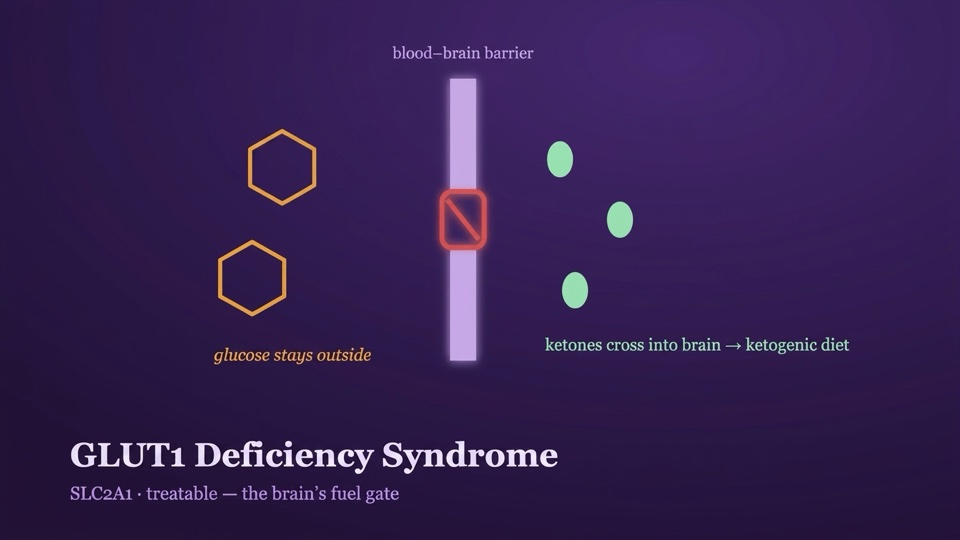
GLUT1 deficiency syndrome is a treatable neurometabolic disorder in which glucose cannot be transported across the blood-brain barrier. The ketogenic diet supplies the brain with an alternative fuel (ketones); in children recognised early, seizures are usually brought under complete control. The problem is this: the presentation is highly variable, and if the test is not considered, children may be followed for years as "drug-resistant epilepsy".
Genetic cause
Changes in the SLC2A1 gene reduce the transporter protein; most cases are de novo, though autosomal dominant familial transmission also occurs (a mildly affected parent may be overlooked — asking about "stiffness in the legs with exercise" in the family history is valuable).
Clinical spectrum
Classic form
- Seizures beginning in infancy with poor response to medication (often brief lapses, absences with eye blinking, myoclonic attacks)
- Slowing of development, a tendency towards acquired microcephaly, unsteadiness
Patterns that should raise suspicion
- Absence epilepsy starting before age 4 → GLUT1 should be screened for
- Findings that worsen with fasting/early morning hours and improve with food
- Paroxysmal exercise-induced dyskinesia (PED): involuntary bending of the legs after walking/running — may be the only finding, without epilepsy
- Intermittent ataxia, episodes of eye-head movement ("aberrant eye movements" in infancy)
Diagnosis
- Lumbar puncture (after 4-6 hours of fasting, with simultaneous blood glucose): low CSF glucose (typically <60 mg/dl, often <40) and a CSF/blood ratio <0.45; CSF lactate is low-normal (distinguishing it from mitochondrial disease)
- Definitive diagnosis: SLC2A1 analysis (sequencing + deletion). If genetic testing is positive, LP is not required; if clinical suspicion is strong but genetic testing is negative, LP is informative
- The EEG may deteriorate with fasting and improve after eating — an informative detail
Treatment — the ketogenic diet, under specialist care
- The classic ketogenic diet (with an experienced team and dietitian) is the main treatment; the target blood beta-hydroxybutyrate is generally in the range of ~2-5 mmol/L. A modified Atkins diet may be used in adolescents/adults
- The response is typically rapid: seizures decrease within days to weeks; movement findings and attention often improve as well
- The diet is maintained at least until the end of adolescence (the brain's energy requirement is highest in childhood); the decision to stop or relax it is made only with the specialist centre
- Medicines to watch for: according to laboratory data, agents that may suppress the GLUT1 transporter — phenobarbital, valproate, high-dose caffeine — should be avoided where possible; if a seizure medicine is needed, options compatible with the diet are preferred
- Diet follow-up includes: growth, lipids, kidney stone prevention (fluids + citrate), and micronutrients such as selenium and carnitine
Three critical points in the emergency department
- 1 · The ketogenic diet is treatment — do not disrupt it: dextrose-containing fluids and sugary syrups break ketosis and worsen symptoms. If intravenous access is needed, start without sugar; discuss any necessary dextrose decision with the diet centre, and check the sugar content of every medicine given.
- 2 · Vomiting/inability to feed = the keto emergency plan: ketosis and hydration are maintained together (monitoring blood ketones + glucose); the problem is not hypoglycaemia but the inability to transport glucose to the brain — the reflex of "let's give sugar to fix it" is wrong in this disease.
- 3 · Note on status epilepticus and medication: after benzodiazepines, levetiracetam is preferred; valproate and phenobarbital should be avoided (transporter inhibition/suppression of ketogenesis). An attack of involuntary bending of the legs after exercise (PED) is not a seizure — it does not require intervention.
Follow-up — summary
The backbone of follow-up: regular review with the diet centre (ketone diary, target range, growth) · lipid profile + kidney stone prevention every 6-12 months (fluids + citrate if needed; ultrasound if symptomatic) · micronutrients (carnitine, selenium, vitamin D) · annual update of the school diet protocol · asking about PED/ataxia at every visit · EEG with any clinical change · checking "not valproate/phenobarbital + sugar-free form" on every prescription · developmental-attention assessment · dental care · genetic counselling (screening for mildly affected family members) + reclassification of VUS. The detailed age-by-age table is in the Routine Follow-up Calendar document at the end of the article.
Prognosis — an honest framework
- Early diagnosis + early diet = the best outcome: seizure control is close to perfect, movement findings largely regress; cognitive development is preserved in proportion to the age at which the diet was started
- Even with late diagnosis, the diet reduces seizures and attacks; however, cognitive effects that have already occurred in the early period may not fully reverse — this is a disease where "the one who suspects it wins"
- Symptoms generally soften in adulthood; in some individuals the diet can be partially relaxed (with the centre's decision)
- In familial cases, recognising a mildly affected parent is important for sibling and pregnancy counselling
Research horizon
- Alternative fuel strategies (e.g. triglyceride derivatives) have been studied; the results are mixed — today the proven standard remains the ketogenic diet
- Gene-based approaches aimed at increasing SLC2A1 expression are at the preclinical stage
Daily life
- A written diet protocol for school: "just one biscuit" breaks ketosis — provide an alternative reward list
- Ketone measurement and planning before long activities; a "keto emergency plan" for illness/vomiting days
- Plan a keto-compatible menu with the dietitian in advance for birthdays and holidays
- Family associations and keto-cooking communities significantly ease the practical burden
Downloadable documents: emergency action plan + routine follow-up calendar (PDF)
Two documents have been prepared for children with GLUT1 deficiency by Nörogender, under the guidance of Prof. Dr. Burak Tatlı. The Emergency Action Plan (3 pages): alongside the 5-minute rule, a "do not disrupt the ketogenic diet — sugar-free fluids" banner, a keto emergency plan (for vomiting/illness days), and preference for levetiracetam + avoidance of valproate/phenobarbital in status epilepticus; an identification section with lines for diet type, target ketone level, and diet centre. The Routine Follow-up Calendar (2 pages): an age-by-age table and record chart built around the ketone diary, lipid-kidney stone monitoring, school protocol, and questioning for PED.
📄 Emergency Action Plan (PDF, 3 pages) — in Turkish 📅 Routine Follow-up Calendar (PDF, 2 pages) — in Turkish
Complete these documents together with your doctor and diet team; keep a copy at home and at school.