Overview
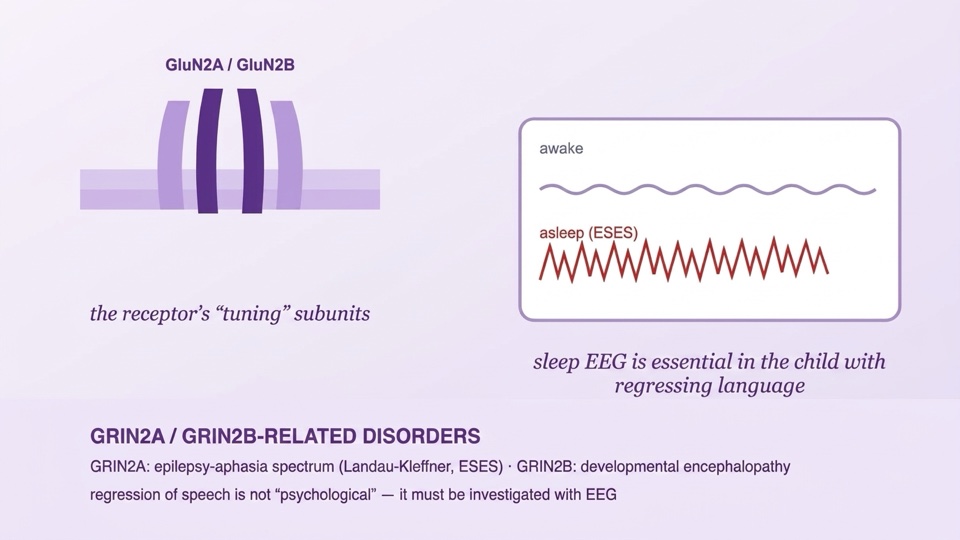
GRIN2A and GRIN2B encode the "tuning" subunits of the NMDA receptor (GluN2A, GluN2B). Although they are sibling genes of the same receptor, in the clinic they tell two separate stories: GRIN2A is the leading genetic cause of childhood's epilepsy-aphasia spectrum (from rolandic epilepsy to Landau-Kleffner syndrome and electrical status epilepticus in sleep — ESES); GRIN2B, on the other hand, mainly causes developmental delay/autism ± epilepsy. Their shared message is this: in a child whose speech or behaviour is regressing, do not request a sleep EEG only to call it "psychological". See the companion article for GRIN1.
Genetic Cause and Mechanism
- GluN2A is the "mature" subunit that replaces GluN2B at synapses towards school age — the fact that GRIN2A disease surfaces during the language-school years with sleep-related epilepsy fits this developmental shift. GluN2B is the subunit of early brain development — and so is the fact that the GRIN2B picture is developmental from infancy onward.
- Variants can be gain-of-function (GoF) or loss-of-function (LoF); both directions cause disease. This distinction determines who is suitable for mechanism-targeted research treatments (below) — if it is not stated in the report, it should be clarified with GRIN variant databases/a specialist centre.
- Most cases are de novo; the milder-end families of GRIN2A (rolandic epilepsy/language problems across generations, with incomplete penetrance) are well recognised — a family history enquiry is important.
GRIN2A — The Epilepsy-Aphasia Spectrum
- Mild end: rolandic (centrotemporal spike)-like epilepsy, with face-arm seizures in sleep; language-articulation problems may accompany it.
- Severe end: Landau-Kleffner syndrome — a previously normal-speaking child losing the ability to understand what is heard (verbal auditory agnosia: "hears but does not understand", with a normal hearing test!) and ESES/CSWS — a flood of spike-wave activity covering most of sleep, with regression of language, cognition and behaviour. Seizures in this picture may be relatively few and subtle; the real disease is in the sleep EEG.
- Rule: A sleep EEG should be requested in every child whose language/school skills are regressing, who seems "as if not hearing", or whose behaviour is deteriorating — a brief outpatient awake EEG may look normal.
GRIN2B — The Developmental Spectrum
- Marked developmental delay/intellectual disability plus frequent autism spectrum features; hypotonia, feeding problems and movement disorders (stereotypy, dystonia) may accompany it.
- Epilepsy is present in only some cases (including infantile spasms), and unlike GRIN2A, the "sleep-EEG disease" pattern is not obligatory; seizure-free GRIN2B is also common.
- For this reason, GRIN2B is also a frequent finding on "autism + developmental delay" panels — the diagnosis changes follow-up (EEG threshold, enquiry about movement disorder).
Diagnosis
- Genetic testing: an epilepsy/neurodevelopmental panel or exome; the GoF/LoF direction of the variant is clarified by specialist assessment; a VUS is reassessed every 1-2 years.
- Sleep EEG is central to suspected GRIN2A (ESES is defined by marked spike-wave activation during sleep); in language regression, it is planned together with a hearing test and language assessment.
- In GRIN2B, EEG is guided by clinical suspicion; a developmental-autism assessment and a movement-disorder video are added to the diagnostic workup. MRI is usually normal in both.
Treatment — An Honest Framework
- GRIN2A/ESES-LKS: The goal is not only to control seizures but to extinguish the EEG flood during sleep (language and cognition are crushed beneath it). Commonly used steps include valproate, ethosuximide, high-dose night-time benzodiazepine (diazepam courses) and corticosteroid courses; sultiame is added in selected cases. Carbamazepine/oxcarbazepine can worsen the EEG and the clinical picture in this spectrum — avoiding them is widely accepted practice. Speech therapy is half of the treatment; even if the picture settles over the years, a language deficit may remain — early and intensive support changes the outcome.
- GRIN2B: Seizures are treated with standard medicines (there is no syndrome- specific prohibition); the main investment is early intensive developmental-communication support (AAC if needed).
- Mechanism-targeted trials: in loss-of-function GRIN2 variants, the NMDA co-agonist serine supplementation, in gain-of-function variants memantine, and for GRIN2B gain-of-function variants a GluN2B-selective modulator (radiprodil) developed for them are all in clinical trials. All of these are at the research stage; they are not a recommendation for clinical use — suitability is assessed at a specialist centre once the direction of the variant is known; enrolment in GRIN registries keeps the door open.
Three Critical Points for Emergencies
- 1 · Standard steps apply in a prolonged seizure; it should be kept in mind that carbamazepine-oxcarbazepine should be avoided in the GRIN2A/epilepsy-aphasia phenotype.
- 2 · "Language/behaviour regression over days to weeks" is an indication for urgent EEG (with a sleep recording) — it should not be attributed to a psychiatric picture and referred elsewhere.
- 3 · Seizures may be subtle (night-time facial twitching, drooling, episodes of being unable to speak) — a video and sleep history should be requested from the family.
Follow-up — Summary
GRIN2A: structured follow-up of language-school function (language assessment every 6-12 months) · sleep EEG at diagnosis and with clinical regression; monitoring treatment response with EEG at the severe end · behaviour-attention screening · a plan to simplify medication as settling is expected towards adolescence. GRIN2B: updating developmental goals every 3-6 months · autism/behaviour assessments · seizure enquiry at every visit (low threshold for EEG) · feeding-sleep · in both, genetic counselling, VUS reclassification and GRIN registries.
Prognosis — An Honest Framework for Families
- GRIN2A: seizures and ESES mostly settle towards adolescence — but traces of language-learning difficulty may remain; the outcome is determined most of all by how early the EEG flood during sleep is extinguished and by the intensity of language support. Children at the mild end can lead a normal school life.
- GRIN2B: the picture is not progressive; development advances slowly but cumulatively. Speech may remain limited — early AAC is always better than waiting for communication to emerge.
- Mechanism-targeted treatments for both genes are being actively investigated on the horizon; a registered and regularly followed patient is the first to hear of study calls.
Daily Life
- Record on video periods of "seeming not to hear", night-time events and speech samples — these guide EEG decisions.
- A written plan for school: support for auditory comprehension (visually supported instructions), a seizure action plan, and a fatigue-sleep schedule.
- Take sleep hygiene seriously: lack of sleep increases both seizures and the ESES burden.
- Join GRIN family associations and international GRIN registries.
Downloadable Documents: Emergency Action Plan + Routine Follow-up Calendar (PDF)
You can download the 3-page emergency action plan prepared by Nörogender under the guidance of Prof. Dr. Burak Tatlı for children with GRIN2A/GRIN2B. Alongside fillable identity/medication fields, what to do during a seizure and the 5-minute rule section, the form includes warnings specific to GRIN2: avoiding carbamazepine/oxcarbazepine in the epilepsy-aphasia phenotype, the "language-behaviour regression = sleep EEG" rule, and enquiry about subtle night-time seizures. The third page is a medical information note for health professionals, containing a summary of ESES-LKS and the steps for status epilepticus.
There is also a Routine Follow-up Calendar (2 pages): two pathways by genotype (A/B) — in GRIN2A, sleep EEG plus a language assessment every 6-12 months and a check on carbamazepine/oxcarbazepine in the prescription; in GRIN2B, developmental-autism follow-up; with an age-by-age table and a record chart.
📄 Emergency Action Plan (PDF, 3 pages) — in Turkish 📅 Routine Follow-up Calendar (PDF, 2 pages) — in Turkish
Fill in the form together with your doctor; keep one copy at home and one at school, and update the rescue medication dose as weight changes.