Overview
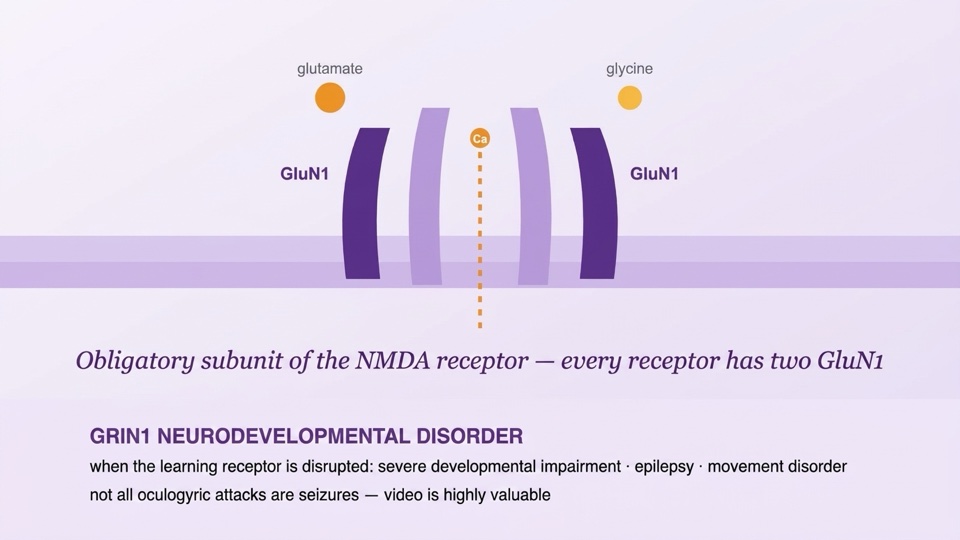
GRIN1-related neurodevelopmental disorder results from changes in the GRIN1 gene, which encodes the obligatory subunit (GluN1) of the NMDA receptor, the brain's "learning receptor". Because every NMDA receptor contains two GluN1 subunits, disruption of this subunit affects the entire receptor — and the clinical picture is correspondingly early and pronounced: the triad of severe developmental impairment, early-onset epilepsy and marked movement disorders. The GRIN family (GRIN1, GRIN2A, GRIN2B…) is grouped under the heading "GRINopathies"; this article covers GRIN1, while the companion article covers GRIN2A/GRIN2B.
Genetic Cause and Mechanism
- The NMDA receptor is a calcium-permeable channel that opens when glutamate and glycine bind together; it is the main switch for strengthening synapses (learning). When GluN1 is disrupted, this switch either does not work enough (loss of function/LoF) or works incorrectly/excessively (gain of function/GoF) — both directions cause disease, and research into treatments is therefore planned according to the direction of the variant.
- The large majority of cases are de novo (occurring for the first time in the family) autosomal dominant changes; the recurrence risk is low but not zero because of parental mosaicism. Rare recessive (biallelic) families have also been reported — this should be asked about during counselling.
- In a subgroup, GRIN1 is associated with a brain developmental malformation (polymicrogyria-like folding anomalies) — this "genetic plus structural" association is a reminder that genetic testing should not be skipped when a structural finding is seen on MRI.
Clinical Picture
- Development: Marked global developmental delay/intellectual disability is present in almost all cases; speech mostly never develops or remains limited to a few words, and autism spectrum features accompany the picture in some. Microcephaly (often acquired) and feeding-swallowing difficulty are common.
- Muscle tone and movement: Hypotonia occurs early; dystonia, chorea, stereotypies and hyperkinetic attacks are added over time. One of the most distinctive findings of GRIN1 is oculogyric-crisis-like eye deviation attacks — the eyes drift upward for minutes, which is usually NOT an epileptic seizure but is very often confused with one.
- Epilepsy (~65-70%): A wide spectrum including infantile spasms, tonic and focal seizures; some cases follow a drug-resistant course. However, in another group of patients epilepsy never develops — the equation "GRIN1 = always severe epilepsy" is not correct.
- Other: Cortical visual impairment (inability to use gaze), sleep problems, periods of restlessness-irritability (approached together with screening for a source of pain), constipation and reflux.
Diagnosis
- Definitive diagnosis is genetic: epilepsy/neurodevelopmental panels or exome sequencing. The functional direction of the variant (gain or loss of function) is not always stated in the report — clarifying this using GRIN variant databases and expert centre opinion is important for research treatments. VUS results should be re-queried every 1-2 years.
- The special role of video-EEG: Distinguishing eye deviation attacks, dyskinetic attacks and true seizures can only be done with video recording; loading medication step by step without making this distinction is a common mistake.
- MRI: Mostly normal or shows subtle atrophy; a folding anomaly is seen in a subgroup. A baseline eye examination (visual function) and a swallowing assessment should be added to the diagnostic package.
Treatment — An Honest Framework
- There is no syndrome-specific drug prohibition; seizures are treated with standard antiepileptics (levetiracetam, valproate, clobazam, topiramate…), and infantile spasms are managed with hormone therapy/vigabatrin according to standard rules. In drug-resistant cases, the ketogenic diet and VNS may be considered.
- Movement disorder is the second half of treatment: during painful dystonic/hyperkinetic periods, a trigger (pain, reflux, constipation, infection) is looked for first; in necessary cases, movement disorder medications are tried under physician management.
- Mechanism-targeted trials: In small series with gain-of-function (GoF) variants, partial responses in seizures/behaviour have been reported with the NMDA blocker memantine; the response is unpredictable and is not expected in loss-of-function-type variants. This is at the research stage; it is not a recommendation for clinical practice — if it is to be tried, it should be done at an experienced centre with the functional direction of the variant known. New molecules aimed at the GRIN family (subunit-selective modulators) are at an early clinical-preclinical stage; the most concrete step for families is participation in GRIN patient registries.
- Supportive care package: nutrition-swallowing support (gastrostomy if needed), visual rehabilitation and attempts at gaze-based communication, physiotherapy-orthotics, sleep regulation and constipation management — these are the main determinants of daily quality of life.
Three Critical Points in the Emergency Setting
- 1 · Standard steps apply in a prolonged seizure (rescue medication + call 112); there is no syndrome-specific contraindication.
- 2 · Eye deviation / hyperkinetic attacks may not be seizures — video should be requested from the family before additional medication is loaded in the emergency department.
- 3 · The risk of aspiration due to swallowing difficulty should be kept in mind; during restlessness attacks, a source of pain (teeth, reflux, constipation, fracture) should be screened for.
Follow-up — Summary
The backbone of follow-up: distinguishing events with a seizure + attack diary (with videos) and video-EEG · updating developmental goals every 3-6 months · asking about nutrition-weight and swallowing at every visit · annual eye/visual function assessment · scoliosis-hip examination (in children with limited mobility) · sleep and behaviour · bone health (annual vitamin D) · genetic counselling and VUS reclassification · participation in GRIN registries.
Prognosis — An Honest Framework for Families
- The GRIN1 spectrum lies predominantly at the severe neurodevelopmental end: independent walking and speech are mostly not achieved; but the picture is not a progressive "loss disease" — gains accumulate, even if slowly, and communication (gaze, buttons, signs) can be established with the right supports.
- Seizures settle over the years in a group of patients; movement disorder and sleep remain the main items on the quality-of-life agenda.
- The two strongest tools for families: a video archive of events (which protects against unnecessary medication) and patient registries (preparation for the era of mechanism-based treatments).
Daily Life
- Video of the attacks plus a brief "attack diary" (duration, trigger, consciousness) form the basis of every check-up.
- Gaze-based selection and simple yes-no systems should be tried early, together with visual support.
- If feeding is exhausting, talk about gastrostomy as a safe feeding tool, not a "defeat".
- GRIN family associations and international GRIN registries: a gateway to both shared experience and research.
Downloadable Documents: Emergency Action Plan + Routine Follow-up Calendar (PDF)
You can download the 3-page emergency action plan prepared for children with GRIN1 by Nörogender, under the guidance of Prof. Dr. Burak Tatlı. The form includes fillable identity/medication fields, what to do during a seizure and the 5-minute rule section, alongside warnings specific to GRIN1: eye deviation / hyperkinetic attacks may not be seizures (the rule of requesting video), the risk of aspiration, and screening for pain during restlessness. The third page is a medical information note summarising the status epilepticus steps for health professionals.
There is also a Routine Follow-up Calendar (2 pages): distinguishing events with video, visual-communication support, nutrition-head circumference monitoring, and an age-by-age table plus a record chart.
📄 Emergency Action Plan (PDF, 3 pages) — in Turkish 📅 Routine Follow-up Calendar (PDF, 2 pages) — in Turkish
Fill in the form together with your doctor; keep one copy at home and one at school, and update the rescue medication dose as weight changes.