
Overview
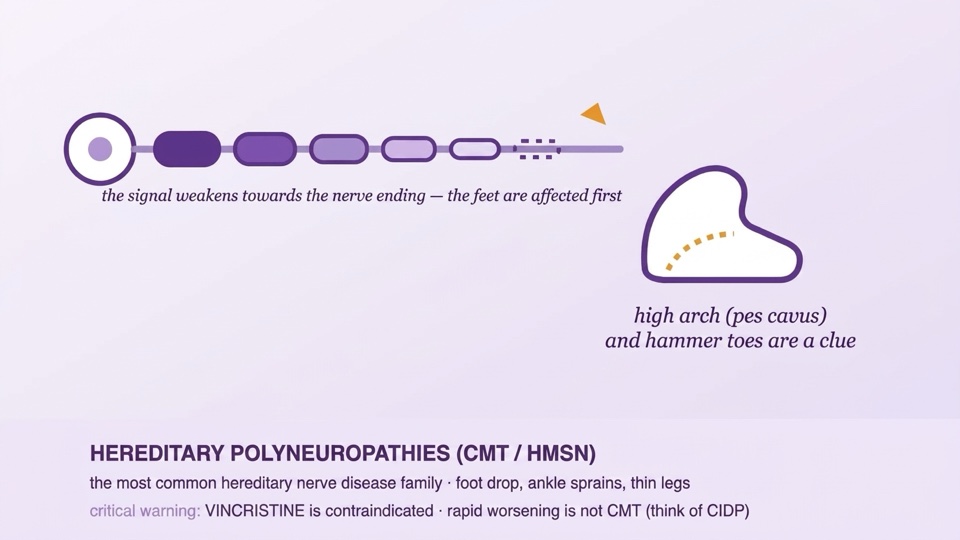
Hereditary polyneuropathies — classically known as the Charcot-Marie-Tooth (CMT) disease family — are the most common group of inherited nerve diseases in childhood (~1/2,500). Peripheral nerves are the longest cables in the body, which is why the picture starts in the feet: frequent ankle sprains, a "clumsy" child who cannot run, high arches (pes cavus) and hammer toes, thinning calves, and disappearing reflexes. Two messages form the backbone of this article: vincristine is contraindicated in these children (a single course can cause permanent, severe paralysis), and rapid deterioration should not be attributed to CMT — weakness progressing over days to weeks may indicate a superimposed, treatable CIDP/GBS.
Genetic Cause and Main Types
- CMT1A (most common; ~40-50%): Duplication of the PMP22 gene; the myelin sheath is disrupted (demyelinating). It is autosomal dominant — a parent often has mild findings, so "no one in the family has it" should not be said without an examination.
- HNPP: Deletion of the same gene — the opposite picture: pressure-sensitive nerves; crossing the legs, leaning on the elbow, or a cast or surgical position can cause acute, painless single-nerve palsies (foot/wrist drop), which usually resolve within weeks.
- CMTX (GJB1): X-linked; males are clearly affected, carrier females are mildly affected.
- CMT2 (e.g. MFN2): It is the axon itself that is affected, not myelin; MFN2 can be early-onset and severe.
- Recessive forms (CMT4, Dejerine-Sottas): In families with consanguinity, early and severe presentations may occur; scoliosis and hip problems may accompany.
- VUS results should be reclassified every 1-2 years; if the panel is negative but the clinical picture is strong, further analysis should be considered.
Clinical Picture
- Gait: late or awkward walking, frequent falls and sprains, a "slapping" sound of the feet when running (foot drop), inability to rise on tiptoe; a steppage gait.
- Feet: pes cavus with hammer toes is almost a signature; calluses and shoe problems are early complaints.
- Hands: fine motor difficulty developing over the years (buttons, pencils), and thenar-interosseous wasting.
- Sensation: reduced pain-temperature/position sense — an unnoticed wound or burn on an insensate foot is a real risk; pain and cramps are also common accompaniments.
- Course: slow progression over years to decades; intelligence and life span are not affected.
Diagnosis
- EMG-nerve conduction is the fork in the road: if conduction velocities are slow, it is demyelinating (CMT1); if amplitudes are low, it is axonal (CMT2). The clue to a hereditary demyelinating neuropathy is that the slowing is uniform across every nerve — in acquired CIDP the slowing is patchy and asymmetric, and conduction blocks are seen.
- Genetic sequence: first a PMP22 duplication/deletion test (the most common cause); if negative, a CMT panel/exome. Examining the parents (± EMG) serves both diagnosis and counselling.
- The golden rule of differential diagnosis: a rapid course, marked asymmetry, proximal involvement or raised CSF protein → think of CIDP, because CIDP responds to treatment (IVIG/steroids) and can also develop on a background of CMT.
Treatment — An Honest Framework
- Today's treatment is supportive and genuinely works: regular physiotherapy and stretching (Achilles tendon), ankle-foot orthoses (AFOs) transform walking safety; suitable footwear and foot/callus care; occupational therapy for the hands.
- Foot surgery (soft tissue/osteotomy) gives the best results in selected cases when planned while the deformity is still flexible — a joint decision with orthopaedics.
- Pain-cramp management should not be neglected (neuropathic pain medications at the physician's discretion).
- Drug safety: vincristine is contraindicated; other neurotoxic drugs (e.g. cisplatin, prolonged metronidazole/nitrofurantoin, amiodarone, colchicine, excessive vitamin B6 doses) require physician screening before prescription.
- Research horizon: ASO/siRNA approaches aiming to reduce PMP22 production in CMT1A, and combined small-molecule studies, are at an early clinical-preclinical stage; all are at the research stage and are not a recommendation for clinical use. CMT patient registries keep the door open to clinical trials.
Three Critical Points in the Emergency Department
- 1 · Vincristine: contraindicated in a child with CMT (or a family history of it) — if oncological treatment is planned, this diagnosis must be reported.
- 2 · Rapid deterioration is not CMT: weakness progressing over days to weeks, with swallowing or respiratory involvement → treatable causes such as GBS/CIDP must be sought.
- 3 · HNPP/pressure: surgical positioning, tourniquets and prolonged pressure can cause acute nerve palsy — the diagnosis must be reported to the anaesthesia team and pressure points protected. Succinylcholine should be avoided in patients with marked muscle wasting.
Follow-up — Summary
The backbone of follow-up: annual foot-orthopaedic examination (progression of arch/deformity, skin and calluses) · reviewing the need for physiotherapy/AFO every 6-12 months · hand function and occupational therapy · scoliosis-hip examination (especially in early-onset/ recessive types) · enquiry about pain and cramps · neurotoxicity check with every new prescription · training in daily skin checks for insensate feet · EMG at diagnosis (no routine repeat needed; repeat if there is clinical change) · family examination plus genetic counselling (50% in dominant types) and VUS reclassification. A detailed age-by-age table is given in the Routine Follow-up Calendar document at the end of this article.
Prognosis — An Honest Framework for Families
- CMT progresses slowly; most individuals walk throughout their lives, and life span is normal. The issue is less about "not being able to walk" than about foot safety, energy cost and hand skill — all of which can be managed with support.
- HNPP follows a course of attacks; precautions (awareness of pressure and position) markedly reduce the number of attacks.
- In early-onset, severe types (MFN2, CMT4) the course is more pronounced; orthopaedic and respiratory follow-up is intensified in these families.
- Temporary worsening may be reported in pregnancy; this should be discussed in advance with adolescent girls.
Daily Life
- Make foot care a daily routine: a skin check every evening (if sensation is reduced), suitable footwear, and monitoring of calluses.
- Frame the AFO as a tool of freedom, not a "defeat" — it reduces falls and fatigue.
- Carry a card in your wallet reading "CMT — vincristine contraindicated / list of neurotoxic drugs" and ask your doctor about it with every new medication.
- In HNPP: watch out for crossing the legs, leaning on the elbow, and carrying a heavy backpack on one shoulder.
- Join CMT associations and registries.
Downloadable Documents: Emergency Action Plan + Routine Follow-up Calendar (PDF)
Two documents have been prepared for children with CMT by Nörogender, under the guidance of Prof. Dr. Burak Tatlı. The Emergency Action Plan (3 pages): the vincristine contraindication and neurotoxic drug warning, the rule "rapid deterioration is not CMT — think of CIDP/GBS", and notes on HNPP/pressure and position and anaesthesia. The Routine Follow-up Calendar (2 pages): an age-by-age table and record chart covering annual foot-orthopaedic review, AFO/physiotherapy, hand function, scoliosis and prescription safety.
📄 Emergency Action Plan (PDF, 3 pages) — in Turkish 📅 Routine Follow-up Calendar (PDF, 2 pages) — in Turkish
Fill in the documents together with your doctor; keep a copy at home and at school.