
Overview
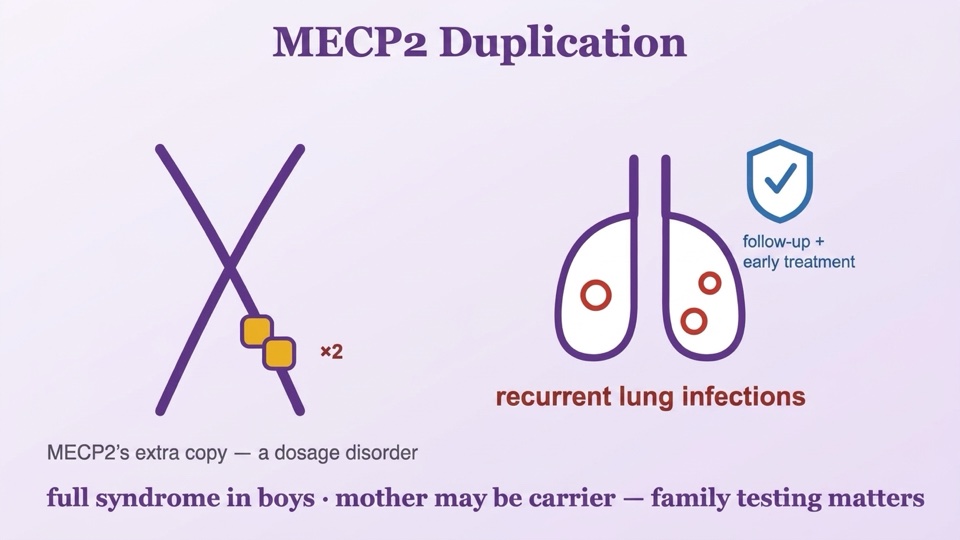
MECP2 duplication syndrome is the "mirror" disorder of Rett syndrome: in Rett, the MECP2 protein is deficient, whereas here it is in excess — and for the brain, both are a problem (MECP2 is a "dosage gene"). The condition is typically seen in boys: hypotonia in infancy, marked developmental delay, speech that never develops or remains very limited, progressive muscle stiffness (spasticity), and, as the most life-threatening feature of this syndrome, recurrent, potentially severe respiratory tract infections. Epilepsy occurs in around half of children and often begins in late childhood. Two practical messages: every episode of fever with cough must be assessed early and seriously, and the mother is usually a healthy carrier — family testing provides vital information for future pregnancies.
Genetic Cause and Mechanism
- A duplication involving MECP2 in the Xq28 region (sometimes larger; it may also encompass neighbouring genes such as IRAK1) → MeCP2 protein is overproduced → synapse maturation and gene expression programmes are disrupted.
- X-linked inheritance: the duplication is often inherited from a healthy carrier mother (X-inactivation in mothers is typically corrective); this is why the recurrence risk for a brother is 50% — genetic counselling is an integral part of this diagnosis. De novo cases also occur; carrier women may be reported to have mild findings (learning-psychiatric).
- The condition is rare in girls and variable depending on the X-inactivation pattern.
- The diagnostic method is not sequencing but copy number analysis (microarray/MLPA); borderline, VUS-like findings should be reassessed every 1-2 years.
Clinical Picture
- Infancy: hypotonia, feeding difficulty, motor delay; mildly coarse facial features may be reported.
- Development: marked intellectual disability; speech most often never develops or remains at a few words; autistic features are common. Regressions in acquired skills associated with periods of severe infection or drug-resistant seizures may be reported — any new loss of skills always warrants a search for a cause.
- Respiratory: recurrent middle ear-sinus-lung infections; pneumonia is the most important risk at every stage of life (immune dysfunction — e.g. impaired antibody response — has been reported). Swallowing difficulty plus reflux increase the risk of aspiration.
- Epilepsy (~50%): often begins around school age; atypical absence, tonic, atonic and generalised tonic-clonic types occur; in some children it may be drug-resistant (a Lennox-Gastaut-like course).
- Other: progressive spasticity (contributing to loss of walking ability with age), constipation and gastrointestinal problems, sleep disturbances, scoliosis.
Diagnosis
- Genetic: Xq28/MECP2 duplication detected by chromosomal microarray (CMA) or MLPA; exome-based copy number analyses may also detect it. If positive, maternal testing and broad family counselling follow.
- Differential diagnosis: this syndrome should be considered whenever intellectual disability of unknown cause occurs together with recurrent infections; Rett syndrome (in girls, loss-of-function variants), Angelman syndrome, Pitt-Hopkins syndrome and other syndromic causes of intellectual disability are distinguished by molecular testing.
- Baseline work-up after diagnosis: immune evaluation (vaccine responses/Ig levels — with immunology input), swallowing assessment, informing the family of the EEG threshold, and spasticity-orthopaedic baseline.
Treatment — An Honest Framework
- There is currently no approved treatment specific to MECP2 duplication; proactive infection management is the life-extending "treatment" in this syndrome: full vaccination (including completion of the pneumococcal schedule; annual influenza vaccine), management of swallowing and aspiration, reflux treatment, respiratory physiotherapy; immunology assessment in cases of severe or recurrent infection (antibody response; protective strategies in selected cases at the physician's discretion).
- Early presentation and a low threshold for assessment in any episode of fever with cough should be a written item in the family's action plan.
- Epilepsy: drug choice is based on seizure type (in presentations dominated by atypical absence-tonic seizures, valproate/lamotrigine/clobazam are the main options; in drug-resistant cases, a ketogenic diet/VNS may be considered) — there is no absolute gene-specific prohibited list, but carbamazepine/oxcarbazepine should be used with caution when there is a generalised component.
- Spasticity-orthopaedics: stretching-physiotherapy, botulinum toxin if needed; scoliosis follow-up.
- Gastrointestinal-sleep: a constipation programme; sleep hygiene ± melatonin at the physician's discretion.
- Research horizon: antisense oligonucleotide (ASO) approaches aimed at lowering MECP2 dosage have corrected the phenotype in animal models and are at an early clinical development stage — this is at the research stage; it is not a recommendation for clinical use. Enrolling in registries is the way to be prepared for eligibility when trials open.
Three Critical Points in the Emergency Department
- 1 · Do not underestimate a respiratory infection: in this syndrome, pneumonia can be severe and is the main life-threatening risk — with fever, cough and rapid breathing, assess with a low threshold (examination, saturation, imaging if needed), consider aspiration, and plan early treatment plus close follow-up.
- 2 · Seizures occur in around half of patients and may begin late: a first seizure at school age is not "a new illness" but a recognised part of the syndrome — standard assessment applies; status epilepticus steps are standard (benzodiazepine → levetiracetam/valproate); ask about the family's rescue plan.
- 3 · Communication and family information: the inability to speak does not mean the child does not understand; inform the follow-up physician at discharge, and if the diagnosis is new, note a referral for maternal carrier testing/genetic counselling.
Follow-up — Summary
The backbone of follow-up: the infection shield (complete vaccination + annual influenza vaccine; asking about the number and severity of infections at every visit; immunology input when indicated) · swallowing-feeding and reflux follow-up · vigilance for seizures at school age (EEG for any suspicious episode) · spasticity-gait and scoliosis examination · constipation programme · sleep enquiry · a communication programme including AAC · dental care · genetic counselling (maternal testing + sibling risk) plus registry enrolment. The detailed age-by-age table is given in the Routine Follow-up Calendar document at the end of this article.
Prognosis — An Honest Framework for Families
- Developmental impairment is marked; most children do not acquire verbal speech — communication is built with AAC. Walking is often achieved, but spasticity can make it harder with age.
- Infections are the main determinant of the course: a proactive shield (vaccination, swallowing management, early treatment) directly affects both life expectancy and quality of life.
- Once seizures begin, some may follow a drug-resistant course; the burden can be reduced with a type-matched drug and, if needed, diet/VNS.
- For family planning: in a carrier mother, each male pregnancy carries a 50% risk — prenatal/preimplantation options should be discussed with genetic counselling.
Daily Life
- Put the rule "fever + cough = early presentation" on the fridge; share it with the school too.
- Have the vaccination record checked at every visit; do not miss the influenza vaccine in autumn.
- Have swallowing complaints (coughing while swallowing, prolonged meals) assessed without delay.
- If a staring or stiffening episode is suspected at school age, record a video — it speeds up the decision on the first EEG.
- Join MECP2 duplication family communities and registries — this is the way to be prepared for eligibility when ASO trials open.
Downloadable Documents: Emergency Action Plan + Routine Follow-up Calendar (PDF)
Two documents have been prepared for children with MECP2 duplication by Nörogender, under the guidance of Prof. Dr. Burak Tatlı. The Emergency Action Plan (3 pages): alongside the 5-minute rule, a banner stating "do not underestimate a respiratory infection — assess with a low threshold," a note on late-onset seizures, and a reminder about maternal carrier counselling. The Routine Follow-up Calendar (2 pages): an age-by-age table and monitoring chart covering the infection shield (vaccination + immunology threshold), swallowing-reflux, vigilance for seizures at school age, spasticity-scoliosis, and AAC.
📄 Emergency Action Plan (PDF, 3 pages) — in Turkish 📅 Routine Follow-up Calendar (PDF, 2 pages) — in Turkish
Complete the documents together with your physician; keep a copy at home and at school.