
Overview
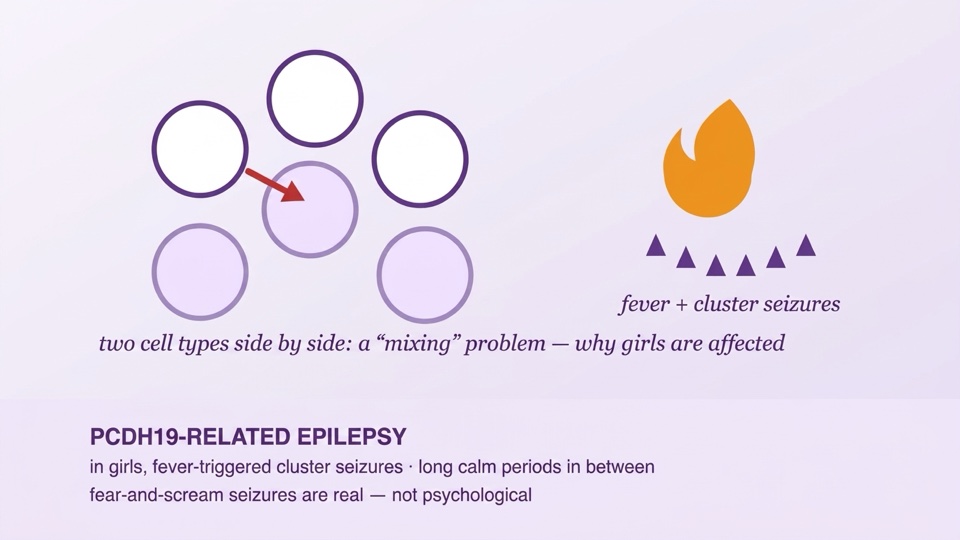
PCDH19-related epilepsy is one of the most curious exceptions in genetics: the condition caused by the PCDH19 gene on the X chromosome almost exclusively affects girls — girls carrying a single faulty copy of the gene become ill, whereas boys whose single X carries the fault entirely are usually healthy carriers. Its clinical signature is also distinctive: short seizures triggered by fever, occurring in clusters (dozens of attacks over a day or two), followed by calm periods lasting months in between. It is the first gene that should come to mind in SCN1A-negative girls with a "Dravet-like" picture — the distinction matters, because drug rules differ from those in Dravet syndrome.
Genetic cause and the "cellular interference" mechanism
- PCDH19 encodes a surface protein (protocadherin-19) that allows cells to recognise one another. Because one of the two X chromosomes in girls is randomly inactivated in each cell, the brain becomes a mosaic of cells with normal PCDH19 and cells with faulty PCDH19 — the coexistence of these two cell populations, which cannot "recognise" each other, leads to instability in neural networks (the cellular interference/mosaicism hypothesis). In boys, all cells are the same (faulty), so there is no interference — and the clinical picture is usually absent too; mosaic boys (carrying two cell types in their body) can, however, become ill just like girls.
- The key point in genetic counselling: About half of cases are de novo; but paternal transmission is possible, and fathers can be healthy carriers — a carrier father passes the gene to all of his daughters (not to his sons). For this reason, testing the parents at diagnosis and discussing the family tree with regard to sisters is essential.
Clinical picture
- Onset: Often between 4 and 18 months of age, frequently on a day of febrile illness.
- Cluster seizures — the hallmark finding: Short (1-2 minute), often focal/tonic seizures recur throughout the day (there may be dozens); clusters last 1-3 days and then stop. Because each individual seizure is short, the family may think it is "mild" — the real emergency is the cluster itself.
- Seizures beginning with a scream of fear: Some attacks begin with an intense expression of fear and a scream (ictal fear) — this presentation may be mistaken for a psychological crisis and delay diagnosis; it is in fact real and epileptic.
- Between episodes: Seizure-free periods lasting months, sometimes years, between clusters are typical; the EEG may be normal during these intervals — a normal EEG does not rule out the diagnosis.
- Development and behaviour: The range is wide: from entirely normal development to intellectual disability and autism spectrum. Anxiety, attention and behavioural problems, along with psychiatric symptoms (in adolescence-adulthood), occur above average and remain a lasting part of follow-up. Status epilepticus can occur but is less typical than in Dravet syndrome.
Diagnosis
- Who should be tested? Any girl with fever-triggered cluster seizures; SCN1A-negative "Dravet-like" presentations; young girls with ictal fear-and-scream seizures.
- Genetics: Epilepsy panel/exome (including PCDH19); if positive, parental testing (for paternal inheritance!) and evaluation of sisters.
- EEG-MRI: EEG during a cluster often shows focal findings; it may be normal in between. MRI is typically normal.
- Distinguishing from Dravet syndrome: In Dravet syndrome, prolonged (status) febrile seizures and hot-bath sensitivity predominate, whereas in PCDH19 clustering of short seizures and long calm intervals are typical; and a critical difference — sodium channel blockers are not forbidden in PCDH19.
Treatment — an honest framework
- Stopping the cluster is the centre of treatment: Every family should have a written cluster plan on hand — with the first seizure, a benzodiazepine bridge (e.g. oral clobazam/diazepam for a few days, as prescribed by the physician) is started; rescue medication is kept ready. Hospital admission is required if the cluster cannot be stopped; in resistant clusters, short courses of corticosteroids have been reported to break the cluster (at the physician's discretion).
- Chronic treatment: Clobazam, levetiracetam/brivaracetam and valproate are among the most commonly used; carbamazepine, oxcarbazepine and phenytoin can be used (the prohibition that applies in Dravet syndrome does not apply here). The choice and sequence are up to the physician; no drug can guarantee complete prevention of clusters — the goal is to reduce their frequency and severity.
- Fever management: Early antipyretics + early contact during febrile illness; vaccinations are continued (with a fever plan for vaccination day).
- Behaviour and mental health: Regular screening and early intervention for anxiety/attention/autism components — in the long term, these determine quality of life more than seizure count does.
- Research horizon: Through the neurosteroid pathway (the observation of allopregnanolone deficiency), ganaxolone has been tried in phase trials in PCDH19 and did not reach its primary endpoint (signals in biomarker subgroups are under discussion); gene-mechanism studies continue. All of this is at the research stage; it is not a recommendation for clinical practice.
Three critical points in the emergency department
- 1 · Cluster logic: If a first seizure has occurred, more are very likely on the way — the family should start the cluster plan early, and the emergency team should not discharge the child saying a single short seizure has "passed"; observation plus the benzodiazepine bridge should be planned.
- 2 · Fear-and-scream seizures should not be assumed to be psychogenic — a video should be requested from the family.
- 3 · There is no need to avoid sodium channel blockers in drug selection out of a Dravet-syndrome reflex; if status develops, the standard steps are applied.
Follow-up — summary
The backbone of follow-up: reviewing the cluster plan at every visit (is the rescue dose updated for current weight, is the bridge medication available at home) · seizure-cluster diary and videos · fever-vaccination day plan · developmental follow-up and annual behaviour-anxiety screening (with mental health support during adolescence) · a cluster action plan within the school plan · genetic counselling (parental testing; sibling risk in a carrier father) · VUS reclassification · participation in patient registries.
Prognosis — an honest framework for families
- The seizure burden is usually heaviest in the first decade; clusters become less frequent towards adolescence and disappear in many patients — the statement "this intensity will not last forever" is based on data.
- The range of developmental outcomes is wide and does not directly correlate with seizure count; early developmental support and mental health follow-up improve outcomes.
- Anxiety and mood problems may persist in adolescence and adulthood; the patient should not be discharged from follow-up, and transition from paediatric to adult neurology should be planned.
- For family planning: a 50% transmission risk from an affected girl to her future children; transmission to all daughters of a carrier father — this should be discussed through genetic counselling.
Daily life
- A single-page cluster plan on the fridge: what to give at the first seizure, at which seizure to go to hospital, and the rescue dose.
- Measure and bring down fever early; set a rule for notifying nursery/school about fever.
- Record seizures on video; recordings of fear-and-scream attacks are of great value in diagnosis and medication decisions.
- Do not delay genetic counselling regarding sisters' status and family planning.
- PCDH19 family communities and registries: experience-sharing and study announcements.
Downloadable documents: emergency action plan + routine follow-up schedule (PDF)
You can download the 3-page emergency action plan prepared by Nörogender under the guidance of Prof. Dr. Burak Tatlı for children with PCDH19. This form has been designed according to cluster logic: alongside the 5-minute rule, a section stating "if a first seizure has occurred, more are on the way — start the cluster plan", a line for the physician to fill in the bridge medication, a warning for the emergency department to "not discharge after a single seizure, but plan for the cluster", a note that fear-and-scream seizures are not psychogenic, and the information that sodium channel blockers are not forbidden (the difference from Dravet syndrome). The third page is a medical information note for health professionals summarising cluster management and the steps for status epilepticus.
There is also a Routine Follow-up Schedule (2 pages): updating the cluster plan/dose at every visit, annual behaviour-anxiety screening from age 3 onwards and mental health follow-up during adolescence, parent-sibling genetic counselling; with an age-by-age table and a record chart.
📄 Emergency Action Plan (PDF, 3 pages) — in Turkish 📅 Routine Follow-up Schedule (PDF, 2 pages) — in Turkish
Fill in the form together with your physician; keep one copy at home and one at school, and update the medication doses as weight changes.