
Overview
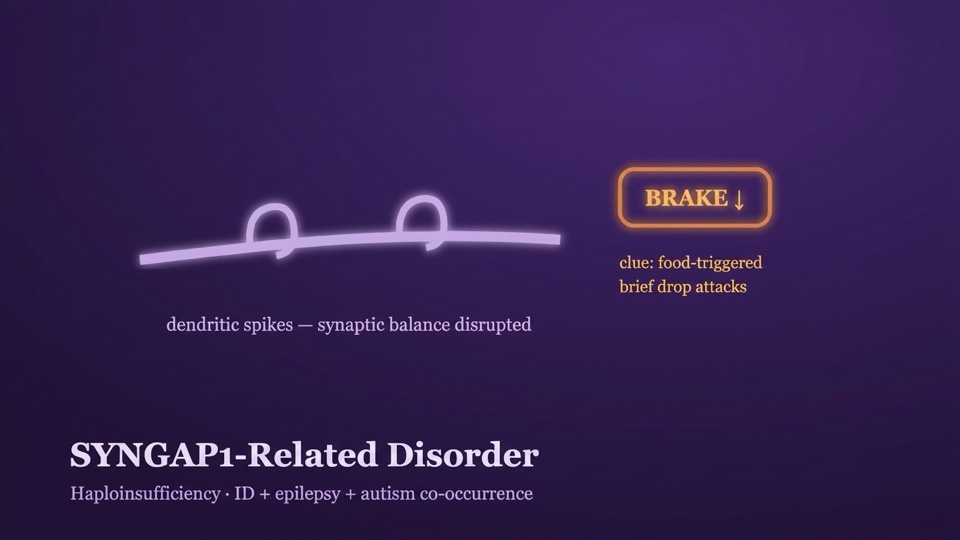
SYNGAP1-related disorder is a neurodevelopmental disease caused by deficiency of one of the synapse's "brake" proteins, combining the triad of developmental delay + epilepsy + autism, and with the spread of gene panels it has become clear that it is one of the most common single genetic causes of this triad. Its clinical signature is the combination of three findings: sudden drop attacks, absences with eyelid myoclonia, and — a clue specific to this gene — reflex seizures triggered by eating. It also has a less well-known but, in the emergency department, vital feature: the pain threshold is high; an injury may be missed simply because the child is not crying.
Genetic Cause and Mechanism
- SYNGAP1 encodes a protein that balances signalling at excitatory synapses (braking the Ras pathway). Insufficiency of a single copy (haploinsufficiency) disrupts both learning processes and electrical balance — this is why development and epilepsy arise from the same mechanism.
- Mutations are almost always de novo; sibling recurrence risk is low (~1%, including the contribution of gonadal mosaicism) — this can be clearly explained to the family. VUS results should be reclassified every 1-2 years.
- The haploinsufficiency mechanism is an ideal target for the "increase production from the intact copy" (ASO) strategy — details are given in the research section.
Clinical Picture
Development and behaviour
- Early hypotonia and delay in milestones; cognitive impairment is usually moderate-to-severe; language is particularly affected — speech may remain limited, and early assessment for alternative communication (AAC) is needed.
- Autism spectrum (~50%), marked sensory differences (over-sensitivity to sounds, high pain threshold), episodes of temper outbursts and self-injurious behaviour, and sleep problems — in the long term, these determine family quality of life more than the seizures do.
- Gait is wide-based and unsteady (ataxic clumsiness); constipation and feeding selectivity are common.
Epilepsy (over 80%)
- The typical seizure triad: sudden drops (atonic/myoclonic-atonic), brief absences with eyelid myoclonia (atypical absence), and myoclonic jerks. Seizures are brief but can occur many times during the day.
- Reflex triggering is the signature of this gene: in up to a quarter of cases, seizures are triggered while eating (chewing-swallowing); eye closure and photosensitivity are also common. The sentence "blinks and drops the spoon while eating" is almost a diagnostic sentence for SYNGAP1.
- Prolonged periods of daze or grogginess may be atypical absence status — these should not be dismissed as "tiredness/medication effect" and should be investigated with EEG.
Diagnosis
- EEG: generalised 2-4 Hz spike-wave discharges; triggering by eye closure and photosensitivity are common — EEG should be performed with an eye-opening-closing and photic stimulation protocol; recording during eating should be considered when possible.
- Definitive diagnosis is genetic (panel/exome). In a picture of "drop attacks + developmental delay + autism", SYNGAP1 should come to mind first.
- Differential diagnosis: Doose syndrome (myoclonic-atonic epilepsy), Jeavons syndrome (eyelid myoclonia), Angelman syndrome and GLUT1 — all present with generalised drop-type pictures; genetic panel testing clarifies the distinction (the fact that the ketogenic diet is therapeutic in GLUT1 carries particular importance).
Treatment — An Honest Framework
- Seizures: because the picture is dominated by generalised-absence-myoclonic features, valproate is among the first-line options; ethosuximide (for absences), lamotrigine (with caution — may rarely worsen myoclonus), clobazam and cannabidiol are reported options; in drug-resistant cases, the ketogenic diet has good reported outcomes. Carbamazepine-oxcarbazepine-phenytoin can worsen these seizure types — they should be avoided.
- Fall safety: while drop attacks continue, a protective helmet should be considered; the home-school environment (sharp corners, stairs) should be reviewed.
- Behaviour-sleep package: behavioural intervention programmes, sensory regulation, sleep hygiene (melatonin if the physician considers it appropriate) — these are as much a priority as epilepsy treatment.
- Research horizon: ASO programmes aimed at increasing SYNGAP1 levels are at the pre-clinical/early development stage; international SYNGAP1 registries are preparing natural history measures. All of these are at the research stage; this is not a recommendation for clinical use — registry participation is the way to access studies. For the current status of treatment candidates, see: Genetic Treatments — SYNGAP1 treatment pipeline.
Three Critical Points in the Emergency Department
- 1 · High pain threshold: not crying after a fall does not rule out injury — assessment for head trauma and fractures should be based on the mechanism, not on behavioural change.
- 2 · Prolonged daze = EEG: this may be atypical absence status; it is assessed with benzodiazepine + EEG. CBZ/OXC/phenytoin should not be loaded.
- 3 · Food-triggered seizures and eyelid myoclonia are real — they should not be mistaken for a "tic/behaviour", and a video should be requested from the family.
Follow-up — Summary
The backbone of follow-up: seizure diary + videos (with enquiry about food triggers) · review of helmet and fall safety every 6-12 months · annual behaviour-autism-sensory assessment and a school plan · sleep enquiry at every visit · constipation management · dental review (every 6 months; trauma related to falls + bruxism) · "not CBZ/OXC" check at every prescription · bone health (annual vitamin D) · genetic counselling + VUS reclassification · participation in SYNGAP1 registries. The detailed age-by-age table is in the Routine Follow-up Calendar document at the end of the article.
Prognosis — An Honest Framework for Families
- Seizures are variable: in one group of patients good control is achieved with medication, while in another the course is drug-resistant and fluctuating; catastrophic deterioration is not an expected course and life expectancy is close to normal.
- Development does not show progressive loss — gains are slow but accumulate; language may remain limited, and early AAC keeps the door to communication open.
- The main long-term agenda is the behaviour-sleep-sensory domain; early and consistent behavioural support markedly eases the adolescent period.
Daily Life
- Mealtime safety: meals should be supervised; if a seizure is triggered, record it; have a plan written for school/nursery stating "a seizure may occur during meals".
- Do not neglect the helmet during drop attacks; set up bathroom-stairs safety.
- Write the information "does not show pain" in the carer-teacher file; set a rule for checks after a fall.
- Videos (including of mealtimes) are the compass for diagnosis and medication decisions.
- Join SYNGAP1 family associations and registries — this is the way to be prepared for the ASO era.
Downloadable Documents: Emergency Action Plan + Routine Follow-up Calendar (PDF)
Two documents have been prepared for children with SYNGAP1 by Nörogender, under the guidance of Prof. Dr. Burak Tatlı. The Emergency Action Plan (3 pages): identity/medication fields and the 5-minute rule, alongside warnings specific to SYNGAP1 — high pain threshold (not crying does not rule out injury), atypical absence status/EEG in prolonged daze, and avoidance of CBZ-OXC-phenytoin, and a note on food-triggered seizures. The Routine Follow-up Calendar (2 pages): helmet-fall safety, annual behaviour-autism screening, a mealtime safety plan, and an age-by-age table plus registry chart.
📄 Emergency Action Plan (PDF, 3 pages) — in Turkish 📅 Routine Follow-up Calendar (PDF, 2 pages) — in Turkish
Fill in the documents together with your physician; keep a copy at home and at school, and update the rescue medication dose as weight changes.