
Overview
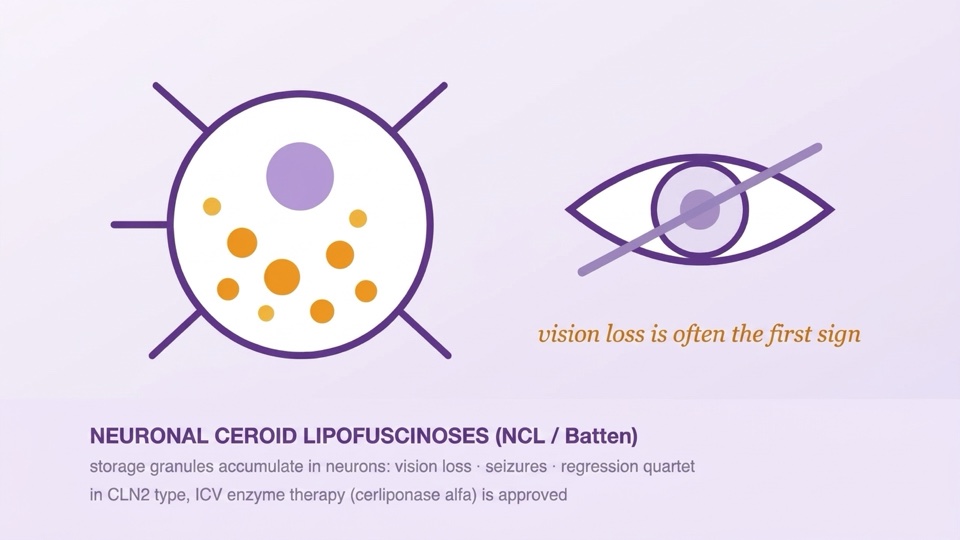
Neuronal ceroid lipofuscinoses (NCL) — commonly known as the Batten disease family — are the most common group of neurodegenerative diseases of childhood (combined ~1/25,000), characterised by the accumulation of waste granules called "ceroid lipofuscin" inside neurons. Disruption of different genes (CLN1 to CLN14) in the lysosome's waste-processing chain leads, in a surprisingly similar way, to the same picture: the triad of vision loss · seizures/myoclonus · cognitive-motor decline (when early loss of life is added, this is called the "clinical quartet"). The historical importance of this group is great, but its current importance is greater still: intracerebral enzyme therapy (cerliponase alfa) is approved for CLN2 type, and early diagnosis saves brain tissue.
Genetic Cause and Mechanism
- NCL genes encode lysosomal enzymes (CLN1/PPT1, CLN2/TPP1, CLN10/cathepsin D) or lysosomal membrane proteins (CLN3, CLN5, CLN6, CLN7, CLN8…). The common result: the neuron's recycling system becomes blocked, autofluorescent granules accumulate, and the most metabolically active neurons (retinal photoreceptors, cortex) are lost first — this is why vision loss occurs early.
- Inheritance is autosomal recessive in almost all cases: the parents are carriers, and the recurrence risk in each pregnancy is 25% — genetic counselling and optional prenatal diagnosis are possible. (A rare adult-onset form can be dominantly inherited.)
- Naming is now gene-based, such as "CLN2 disease". The same gene may have severe/mild (protracted) variants — residual enzyme activity can soften the course.
Main Types by Age
CLN1 (PPT1) — infantile type
- Rapid decline between 6-24 months, acquired microcephaly, hand stereotypies and excessive startle to stimuli; vision fades early, and the EEG rapidly becomes impoverished ("EEG progressing to isoelectric").
- Pitfall: due to hand stereotypies plus regression, this can be mistaken for Rett syndrome — in MECP2-negative "Rett-like" girls and boys, PPT1 enzyme/genetic testing should be kept in mind. Later-onset (juvenile) PPT1 variants also exist.
CLN2 (TPP1) — late infantile type: the NCL with a treatment
- Typical scenario: in a child whose speech is already delayed, the onset of afebrile seizures between 2-4 years of age, followed within months by rapid erosion of language-motor skills, with pronounced myoclonus and ataxia; vision loss usually appears after the seizures.
- EEG clue: occipital spike response to low-frequency (1-2 Hz) intermittent photic stimulation — "late infantile regression plus this EEG finding" is almost diagnostic.
- Treatment: Cerliponase alfa is an enzyme given every two weeks into the brain ventricle (ICV port); it markedly slows motor-language loss. The benefit is preserving function at the point treatment is started — what is lost does not return; therefore it is vital that a clinician seeing "language delay plus new seizures" requests TPP1 enzyme testing early. Detailed guide: the CLN2 (Batten) article.
CLN3 — juvenile type: "from ophthalmologist to neurologist"
- Begins at 4-7 years of age with rapidly progressive vision loss in a school-age child; fundus/ERG findings resemble retinitis, and the child may be followed for years with only a diagnosis of "retinitis pigmentosa". Rule: CLN3 should come to mind in any child with rapid vision loss plus a change in learning-behaviour.
- 2-5 years after vision loss, cognitive slowing, seizures, hesitant-repetitive speech, parkinsonism in adolescence, and behavioural-psychiatric symptoms (anxiety, periods of hallucination) are added; cardiac conduction problems have been reported in the late stage → intermittent ECG from adolescence onward is reasonable.
- The course extends over decades; some patients reach adulthood.
Other Members
CLN5, CLN6, CLN7, CLN8 produce late-infantile-variant pictures (one form of CLN8, called "Northern epilepsy", is slower); CLN10 can begin catastrophically at birth/early infancy; the adult-onset form (Kufs) is rare. The common language is the same in all: the vision-seizure-regression axis, distinguished by age and speed.
Diagnosis
- Two rapid tests when suspicion arises: PPT1 and TPP1 enzyme activity on dried blood spot (captures CLN1-CLN2 within hours-days) plus simultaneous genetic panel/exome (all CLN genes). If the enzyme is low, referral to a treatment centre is planned without waiting for genetic confirmation.
- Eye: fundus examination (macular changes), ERG fades early; joint evaluation with ophthalmology when CLN3 is suspected.
- EEG: low-frequency photic response in CLN2; generally background slowing plus multifocal discharges. MRI: cerebral and cerebellar atrophy predominate; white matter signal increase is secondary (a clue distinguishing it from leukodystrophies).
- The historical steps (curvilinear/fingerprint bodies on skin biopsy) have now been replaced by enzyme and genetic testing.
Treatment — An Honest Framework
- CLN2: cerliponase alfa (above) — approved; port infection monitoring and the two-weekly schedule are a serious but manageable burden for the family.
- Seizures/myoclonus: valproate, levetiracetam/brivaracetam, clobazam, perampanel are commonly used; carbamazepine, oxcarbazepine, phenytoin, and high-dose lamotrigine can worsen myoclonus — the rules for progressive myoclonic epilepsy apply (see the PME guide).
- Support package: vision rehabilitation and blindness skills training should start early; nutrition-swallowing (timing of gastrostomy), spasticity-dystonia management, sleep, constipation, pain-comfort; careful drug selection for psychiatric symptoms (in CLN3).
- Research horizon: gene therapy and ASO studies for CLN3/CLN5/CLN7, and enzyme/gene approaches for CLN1 are at an early clinical-preclinical stage; participation in patient registries is a pathway to access to studies. All of these are at the research stage; they are not a recommendation for clinical use.
Follow-up — Summary
The backbone of follow-up: a seizure-myoclonus diary and medication adjustment · vision/ERG and a vision-hearing support plan every 6-12 months · swallowing-nutrition assessment (discussing gastrostomy before the weight curve drops) · physiotherapy-orthotics and scoliosis examination · sleep and behaviour · intermittent ECG from adolescence onward in CLN3 · port care and infusion schedule if on CLN2 treatment · genetic counselling at every diagnosis (25% recurrence risk) and evaluation of siblings — in CLN2, if a new sibling is identified presymptomatically, treatment can be started early.
Prognosis — An Honest Framework for Families
- NCLs are progressive; type determines the course: the CLN1 infantile form is the fastest, CLN2 without treatment shows severe loss in the 6-12 year age band, and CLN3 shows a course extending over decades. Variant/protracted forms are slower.
- In CLN2, treatment has changed the equation: in cases started early, walking and speech have been shown to be preserved for years — which is why prognosis in this group now depends on "speed of diagnosis".
- Vision loss is expected in all types; early blindness education preserves the child's connection to the world.
- Goals are updated with the stage: skill preservation → comfort and freedom from pain → care that the family can sustain. The palliative team should be introduced early.
Daily Life
- Seizure-myoclonus videos and a simple skills diary are the best compass for medication decisions.
- As vision decreases, the home layout should be kept consistent; auditory-tactile play and communication should be established early.
- A written plan for school/rehabilitation: a seizure action plan plus vision support plus swallowing precautions.
- Family associations (Batten families) and international registries: a gateway to both experience and access to studies.
- Options for prenatal/presymptomatic testing in sibling pregnancies should be discussed with the physician.