
Overview
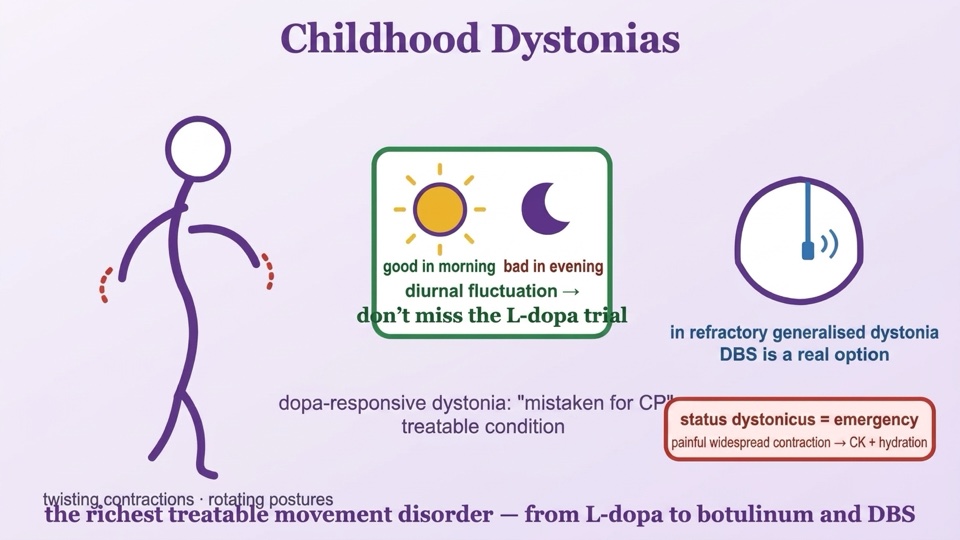
Dystonia consists of twisting movements and rotating postures caused by involuntary, sustained and repetitive muscle contractions — the child's foot turns inward while walking, the hand curls while writing, the neck is pulled to one side. A significant proportion of childhood-onset dystonias are genetic, and this group is one of the areas in paediatric neurology with the richest range of treatment options: at one end, dopa-responsive dystonia that improves dramatically with low-dose L-dopa, and at the other, deep brain stimulation (DBS), which is life-changing in drug-resistant generalised dystonia. The three golden sentences of this guide: an L-dopa trial should be considered in every childhood dystonia; every childhood dystonia should be screened for Wilson disease (both conditions are treatable); and status dystonicus is an emergency — a picture of painful, widespread, unremitting contractions must be managed in hospital without delay.
Genetic Cause and Main Types
- DYT-TOR1A (DYT1; dominant, penetrance ~30%): often begins in one leg or arm during school age-adolescence and may spread (generalise) over the years; intellect is not affected. This is the group that responds best to DBS — early referral in resistant cases changes the outcome.
- DYT-KMT2B (DYT28; often de novo): one of the common causes of childhood-onset generalised dystonia; craniocervical spread involving speech and swallowing, starting from the leg, is typical; it may be accompanied by mild learning impairment and short stature-microcephaly. Good responses to DBS have been reported.
- Dopa-responsive dystonia (DRD/Segawa; GCH1-dominant, rarer TH/SPR-recessive): the typical history is diurnal fluctuation — gait that is almost normal in the morning and worsens towards evening; some children thought to have "cerebral palsy" actually have this. Dramatic and lasting improvement is achieved with low-dose L-dopa; missing this opportunity is one of the most painful examples of preventable disability.
- Myoclonus-dystonia (DYT-SGCE; dominant, more pronounced when inherited from the father): lightning-like myoclonic jerks in the upper trunk plus mild dystonia; anxiety-OCD may accompany it.
- ATP1A3 spectrum: sudden dystonia-parkinsonism that develops over days (RDP), or attacks of unilateral/bilateral flaccidity-dystonia in infancy (alternating hemiplegia); fever-stress acts as a trigger. "Rapid-onset dystonia = think of ATP1A3."
- Related guides: see the pages on PRRT2 (PKD) for short movement-triggered attacks, GNAO1 for severe early dyskinesia-seizure combinations, and CACNA1A for episodic presentations.
- VUS results are reclassified every 1-2 years.
Clinical Picture and Diagnostic Pathway
- Distribution: focal (single region) → segmental → generalised; onset in the leg with spread in childhood suggests genetic dystonia. It increases with action and disappears during sleep; a "sensory trick" (such as the neck straightening when the cheek is touched) is the hallmark of dystonia.
- Essential questions: is there diurnal fluctuation (DRD)? Was a new medication started (acute dystonic reaction)? Did onset occur over days (ATP1A3)? Is there a similar/mild picture in the family (incomplete penetrance)?
- Essential screening: Wilson disease (ceruloplasmin + 24-hour urinary copper ± eye examination) in every childhood-adolescent dystonia; brain MRI (basal ganglia — NBIA/"eye-of-the-tiger" sign, bilirubin-hypoxia traces, Wilson findings); metabolic screening if needed.
- Genetics: dystonia panel/exome (including TOR1A deletion analysis); family examination-counselling according to inheritance pattern.
- Differential diagnosis: dyskinetic cerebral palsy (static course + history), tics (suppressible, with a premonitory urge), psychogenic movement disorder (variable, distracted with attention), spasticity (velocity-dependent resistance — see the SPG guide).
Treatment — An Honest Framework
- First-line treatment is always an L-dopa trial (with carbidopa, titrated from a low dose, for a sufficient duration): a dramatic response in DRD is both diagnostic and lifelong treatment; if there is no response it is tapered off gradually — it costs nothing to try and may bring great benefit.
- Oral medications: trihexyphenidyl (children tolerate high doses better than adults when titrated slowly; dry mouth-blurred vision-urinary retention are monitored), baclofen, clonazepam; tetrabenazine in selected cases. The goal is kept realistic: improving pain, function and ease of care.
- Botulinum toxin: effective and safe in focal-segmental dystonia (neck, hand, calf) in 3-4 month cycles.
- GPi-DBS (deep brain stimulation): reported to provide marked and lasting benefit in drug-resistant generalised dystonia, particularly in TOR1A and KMT2B; early assessment before fixed skeletal deformities become established improves outcome — it is not a "last resort" but an option to be considered in good time. The decision and procedure are carried out at an experienced movement disorders-DBS centre.
- Intrathecal baclofen in selected cases of mixed dystonia and spasticity.
- Status dystonicus preparedness: in resistant-generalised cases, the family knows a written flare-up plan (triggers, first response, which hospital).
- Research horizon: gene-specific approaches are at the preclinical stage; they are at the research stage and are not a recommendation for clinical use.
Three Critical Points in the Emergency Department
- 1 · Status dystonicus is an emergency: painful, widespread, unremitting contractions that worsen over hours to days → CK and renal monitoring (rhabdomyolysis!), aggressive hydration, pain-fever control, stepwise sedation (starting with a benzodiazepine), a low threshold for early ICU admission. Looking for triggers: infection, pain (dental-constipation-fracture), discontinuation of medications and battery depletion/device malfunction in a child with DBS — the device team should be contacted.
- 2 · Recognise acute dystonic reaction: a sudden neck-eye-jaw crisis after starting a new antiemetic/antipsychotic (including metoclopramide) → resolves within minutes with biperiden or diphenhydramine; it is not a seizure, EEG is not required; the responsible drug is discontinued.
- 3 · In a child with DBS: do not turn off the device or bring a magnet near it; MRI only according to the device's conditions (with the device team); diathermy is prohibited; in sudden deterioration, check the battery-programme first.
Follow-up — Summary
The backbone of follow-up: video archive (the same tasks — walking, writing, holding a cup — once a year and with medication changes) · documenting the L-dopa trial and Wilson screening in the file · accounting for medication titration-adverse effects (asking about anticholinergic effects with trihexyphenidyl) · planning the botulinum cycle · not delaying DBS assessment in resistant generalised cases; battery-programme checks scheduled in patients with DBS · asking about pain-sleep · hip-scoliosis follow-up in severe cases · speech-swallowing assessment in KMT2B · anxiety-mental health screening in SGCE · school plan (writing-time adaptation, allowance for fatigue) · genetic counselling + VUS reclassification. The detailed table is in the Routine Follow-up Calendar document at the end of this article.
Prognosis — An Honest Framework for Families
- Dystonia typically does not shorten life; the issue is function, pain and the burden of care — all three can be meaningfully improved with today's tools.
- In DRD the picture reverses almost completely — this is why the L-dopa trial must not be skipped in any child.
- In generalised types such as TOR1A/KMT2B, medications often remain only partially effective; lasting gains in walking, speech and independence have been reported with DBS — timing matters.
- Penetrance may be incomplete: some family members carrying the variant never develop findings; counselling is given with this balance in mind.
Daily Life
- Record the same tasks on video once a year (walking down the hallway, writing a sentence, drinking from a cup); repeat with medication changes — it is a compass for decisions.
- Discover and use "sensory tricks" (improvement with touch) — this both helps in daily life and supports the diagnosis.
- Note diurnal fluctuation: the morning-evening difference is the gateway to the L-dopa question.
- Remind your doctor about the antiemetic-antipsychotic group when new prescriptions are given (have it noted on your card if there is a history of acute dystonic reaction).
- In a child with DBS, keep battery level checks on a calendar; always carry the device identification card.
- Join dystonia family associations and registries.
Downloadable Documents: Emergency Response Plan + Routine Follow-up Calendar (PDF)
Two documents have been prepared for children with dystonia by Nörogender, under the guidance of Prof. Dr. Burak Tatlı. The Emergency Response Plan (3 pages): in this group the focus is not seizures but crisis — status dystonicus thresholds (CK-renal-hydration), an acute dystonic reaction box (biperiden/diphenhydramine) and DBS device warnings (battery-MRI-diathermy); identification lines for L-dopa/trihexyphenidyl and DBS. The Routine Follow-up Calendar (2 pages): a table and record chart built around the video archive, L-dopa/Wilson records, the botulinum cycle, DBS assessment-battery calendar and school plan.
📄 Emergency Response Plan (PDF, 3 pages) — in Turkish 📅 Routine Follow-up Calendar (PDF, 2 pages) — in Turkish
Complete the documents together with your doctor; keep a copy at home and at school; carry it together with the device card in a child with DBS.