Overview
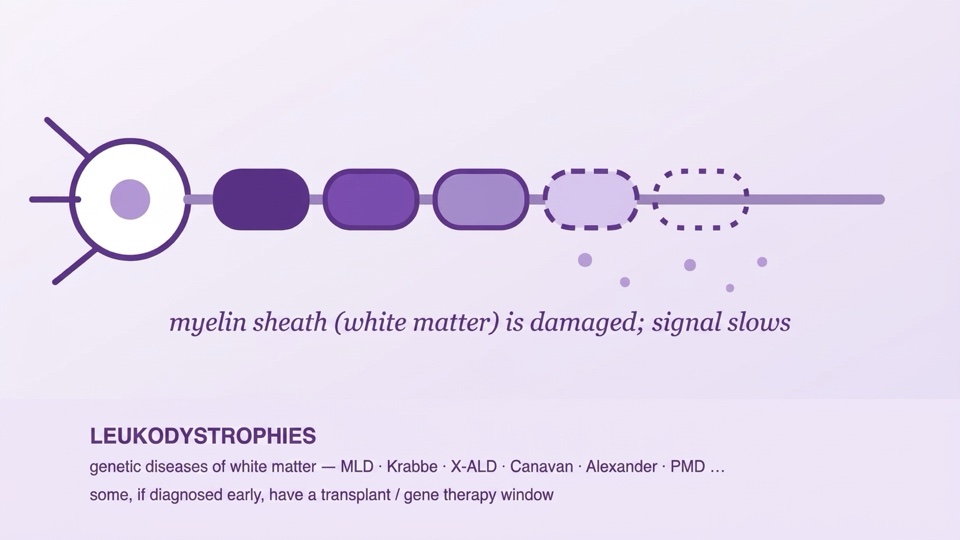
Leukodystrophies are genetic diseases of the myelin sheath (white matter) that "insulates the brain's wiring": myelin is either never formed correctly (hypomyelination) or is broken down after it is formed (demyelination). Individually they are rare; but as a group they occur in approximately 1 in every 7,000-8,000 births, and they are among the most important causes of the "child who gains skills and then loses them" picture in paediatric neurology. This article describes the group's common language: when to suspect it, how MRI guides the way, and which conditions have a treatment window. In-depth guides to individual diseases are also available and linked within the text.
When to Suspect?
- Regression: Stalling and reversal of acquired skills (walking, speech, hand use) — the common warning sign of leukodystrophies.
- Motor picture predominant: Progressively increasing spasticity (stiffness), balance impairment, a gait that becomes clumsy; meanwhile seizures (initially) remain relatively in the background.
- At the hypomyelinating end: Nystagmus + severe hypotonia from birth, with motor milestones never achieved at all (e.g. Pelizaeus-Merzbacher).
- Pitfalls: In the early period it is often mistaken for "cerebral palsy" — CP does not progress; every 'CP' that progresses must be reconsidered. Forms that begin insidiously in school age with behavioural-attention deterioration (X-ALD) may first receive an ADHD/psychiatric diagnosis.
The Diagnostic Path: MRI First, Then Genetics
The most powerful tool when leukodystrophy is suspected is brain MRI: the pattern of white matter involvement (anterior or posterior, symmetric or not, whether U-fibres are spared, whether it enhances with contrast) narrows the list of diseases down to a few candidates. Targeted biochemistry (very long chain fatty acids, arylsulfatase A, galactocerebrosidase, NAA…) and a genetic panel/exome then establish the diagnosis. Practical order: MRI pattern → biochemical confirmation → genetic confirmation → family counselling.
Main Leukodystrophies — A Panorama
| Disease (gene) | Typical clue | Treatment window |
|---|---|---|
| MLD (ARSA) | Deterioration and regression of gait at 1-2 years of age; peripheral nerve is also affected (reflexes may disappear) | Yes — gene therapy (atidarsagene) in the presymptomatic/very early period, and transplantation in selected cases; the window closes rapidly once symptoms become established |
| Krabbe (GALC) | Extreme irritability + stiffness + feeding difficulty in the first months; CSF protein is high | Yes — presymptomatic transplantation only (this is why it is included in newborn screening in some countries); transplantation does not alter the course in a symptomatic infant |
| X-ALD (ABCD1) | Behavioural-attention deterioration + visual/auditory processing problems in a school-age boy; adrenal insufficiency may accompany it | Yes — transplantation/gene therapy in the early cerebral stage; cortisol is life-saving in adrenal insufficiency (details below) |
| Canavan (ASPA) | Macrocephaly + severe hypotonia in the first months; NAA peak on MR spectroscopy | Supportive treatment; gene therapy studies are ongoing |
| Alexander (GFAP) | Macrocephaly + predominantly anterior (frontal) involvement; bulbar findings | Supportive treatment; an ASO study is at the clinical stage |
| PMD (PLP1) | Congenital nystagmus + hypotonia; myelin is never formed at all (the hypomyelinating prototype) | Supportive treatment; cell/gene approaches are at the research stage |
| VWM / CACH (EIF2B1-5) | Stepwise deterioration with febrile illness or head trauma; on MRI the white matter progressively "turns to water" | Supportive care + protection from triggers (fever control, helmet, vaccinations); targeted molecules are at the research stage |
| AGS (TREX1 etc.) | Early encephalopathy + calcifications + chilblain-like skin lesions ("TORCH without TORCH from birth") | Treatments targeting the interferon pathway (JAK inhibitors) are used in selected cases |
| Zellweger spectrum (PEX) | Severe hypotonia + dysmorphism + liver findings in the newborn; peroxisomal panel is abnormal | Supportive treatment + organ follow-up |
Most of the diseases named in the table have a detailed guide on this site — you can reach it via the link in the row.
X-ALD — The Most Important Member Without Its Own Article on This Site
X-linked adrenoleukodystrophy (ABCD1 gene) is known as the leukodystrophy of boys, but it actually has three faces, and two of them can be managed with treatment:
- 1 · Cerebral ALD (boys aged 4-10): The most insidious onset is at school — distractibility, decline in academic performance, behaving "as if not hearing", visual processing problems. On MRI, symmetric involvement starting posteriorly (parieto-occipital) that enhances with contrast is typical. Haematopoietic stem cell transplantation can halt progression at the early lesion stage; gene therapy (eli-cel) has been used in selected cases — centre experience is essential because of the risk of haematological adverse effects during follow-up. Once the lesion becomes established the window closes: this is why at-risk brothers in every family with a diagnosed case must be screened and followed with MRI.
- 2 · Adrenal insufficiency (Addison's): This develops in a large proportion of boys with ALD and may be the only finding years before the neurological picture (fatigue, vomiting episodes, skin darkening, salt-wasting crises). ACTH-cortisol must be checked and regularly monitored in every boy at diagnosis; hydrocortisone replacement is life-saving. VLCFA (very long chain fatty acids) should be requested in every boy with unexplained Addison's disease.
- 3 · Adrenomyeloneuropathy (adult): Slowly progressive gait difficulty-spasticity in adulthood, including in carrier women; one of the reasons for family screening.
In some countries X-ALD has been included in newborn screening (the aim being to catch it before an adrenal crisis and before the transplant window is missed); it is not in routine screening in our country — if there is a family history, targeted testing should be considered.
"Not a Leukodystrophy But Enters Through the Same Door": Distinguishing Grey Matter Disease
Two other large groups enter the same differential diagnosis in a regressing child, but these are diseases of the neuron itself rather than the white matter, and their clues differ:
- Neuronal ceroid lipofuscinoses (NCL/Batten): regression is accompanied by vision loss and seizures/myoclonus; on MRI, atrophy stands out before white matter changes.
- Infantile neuroaxonal dystrophy (INAD/PLAN): regression + eye findings + denervation on EMG and cerebellar atrophy on MRI in an infant — it can mimic white matter disease but has a distinct signature.
Practical rule: regression + spasticity + symmetric white matter on MRI → the leukodystrophy path; regression + vision loss/seizures → the NCL path; regression + denervation/cerebellum → the INAD path.
Treatment — An Honest Framework
- Time is critical: In MLD, Krabbe and X-ALD, treatment (transplantation/gene therapy) can alter the course when applied before symptoms become established; this is why sibling screening, rapid diagnosis and early referral to an experienced centre are the "emergencies" of this field.
- What can be done for every patient: spasticity management (physiotherapy, botulinum, baclofen), seizure treatment, feeding-swallowing support (gastrostomy if needed), respiratory and orthopaedic follow-up, pain-comfort, family support — these determine quality of life even in forms said to have "no treatment".
- Research horizon: ASOs (at the clinical stage in Alexander), gene addition studies (expansion to other forms after Canavan, MLD), targeted small molecules in VWM — all of these are at the research stage; they are not a recommendation for clinical use.
Prognosis — An Honest Framework for Families
- Prognosis varies greatly by disease and age of onset: as a general rule, the earlier the onset, the faster the course; later-onset forms are spread over years.
- In MLD/Krabbe/X-ALD cases where the treatment window is caught, a long, functional life is possible — the equation "leukodystrophy = nothing can be done" is no longer true.
- In progressive forms the goal changes: preserving skills, a comfortable daily life free of pain, and a care plan the family can sustain. The palliative care team should be introduced early, not as a sign of the "final stage" but as a partner in quality of life.
Daily Life
- Family screening and genetic counselling should be considered at every diagnosis (MRI-adrenal follow-up for brothers in X-ALD; testing at birth for new siblings in MLD/Krabbe).
- Early contact in febrile illnesses — a trigger in VWM, and a swallowing-respiratory burden in all of them.
- Vision-hearing-processing assessments should be added to the school/rehabilitation plan.
- Patient associations and registries: the gateway to access to new studies.